
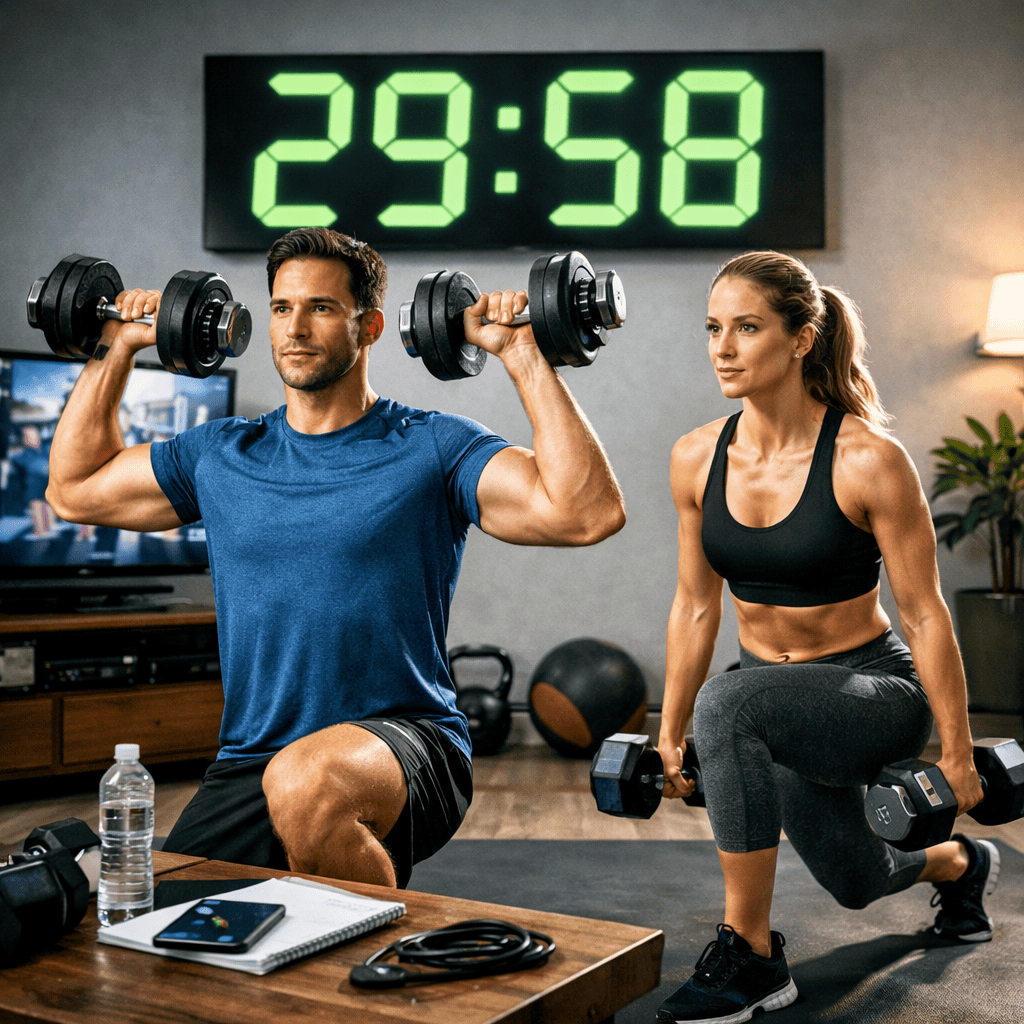
If you’re wondering what makes 30-minute workouts effective, the answer isn’t just time management — it’s intentional programming.
Understanding what makes 30-minute workouts effective can help you avoid wasted effort and focus only on the training principles that produce results.
What makes 30-minute workouts effective is the combination of structured strength training, progressive overload, and focused execution.
When workouts are built with purpose rather than randomness, shorter sessions can produce consistent strength gains and measurable fat loss.
For busy professionals, efficiency matters more than time spent in the gym.
Understanding what makes 30-minute workouts effective lets you focus on proven principles rather than guessing what might work.
Table of Contents
Why 30 Minutes Can Be Enough
Long workouts are not required for results. What matters most is:
- Progressive overload
- Intensity
- Consistency
- Calorie balance
- Movement quality
So what makes 30-minute workouts effective compared to longer sessions? The key difference is efficiency. These workouts eliminate wasted time and emphasize high-impact movements that drive measurable progress.
Muscle responds to tension — not time.
Fat loss responds to calorie control — not duration.
When structured correctly, 30 focused minutes can deliver the same stimulus as much longer workouts.
What Must Be Included for 30-Minute Workouts to Work?
1. Compound Movements
Exercises like:
- Squats
- Deadlifts
- Push-ups
- Rows
- Lunges
Compound movements recruit multiple muscle groups at once, allowing you to maximize results in less time.
2. Progressive Overload
Progressive overload drives muscle growth, as supported by strength training guidelines from the American College of Sports Medicine.
You must gradually increase:
- Weight
- Reps
- Sets
- Intensity
If you’re unsure how to structure progression, Greg’s 30-Minute Blueprint includes weekly progression phases built over 12 weeks.
3. Minimal Distractions
Thirty minutes only works if you:
- Avoid long rest periods
- Limit phone use
- Stay focused
- Follow a clear plan
Efficiency beats randomness every time.
Sample 30-Minute Strength Session
Here’s a simple example:
Warm-Up (5 Minutes)
- Bodyweight squats
- Arm circles
- Light dumbbell rows
Circuit A (10 Minutes)
- Goblet squats – 10 reps
- Push-ups – 10 reps
- Bent-over rows – 10 reps
Repeat 3 rounds.
Circuit B (10 Minutes)
- Reverse lunges – 10 each leg
- Shoulder presses – 10 reps
- Plank – 30 seconds
Optional Finisher (5 Minutes)
- Jump rope or fast-paced bodyweight circuit
That’s it. Focused. Efficient. Done.
Who 30-Minute Workouts Work Best For
Thirty-minute workouts are especially effective for:
- Busy professionals
- Parents with limited time
- Adults over 35
- People training at home
- Anyone rebuilding consistency
If your schedule is unpredictable, shorter workouts reduce friction and improve long-term consistency.
For many busy professionals, learning what makes 30-minute workouts effective removes the pressure to train longer and shifts the focus toward consistency.
For many professionals, learning what makes 30-minute workouts effective removes the pressure to train longer and reinforces the value of consistency.
Common Mistakes That Make 30 Minutes Ineffective
Even short workouts can fail if:
- There’s no progression
- Exercises are random
- Intensity is too low
- Nutrition isn’t aligned
- Sessions are skipped frequently
Structure matters more than duration.
What Makes 30-Minute Workouts Effective for Fat Loss?
Fat loss is primarily determined by:
- Calorie balance
- Protein intake
- Daily activity level
- Strength training consistency
You do not need hours of cardio.
Fat loss primarily depends on calorie balance, according to guidance from the CDC.
Strength training preserves muscle, supports metabolism, and improves long-term results when paired with simple nutrition guidelines, such as those outlined in Greg’s 30-Minute Blueprint.
Is 30 Minutes Enough to Build Muscle?
For beginners and intermediates — absolutely.
As long as you:
- Train each muscle group 2–3 times weekly
- Apply progressive overload
- Eat adequate protein
- Recover properly
Muscle growth is possible within short sessions. Adequate protein intake supports muscle repair and growth, as outlined by the International Society of Sports Nutrition.
Advanced bodybuilders may require more volume — but most busy professionals do not.
How to Make 30 Minutes Work for You
If you want real results:
- Schedule 3 fixed workout days per week
- Prioritize compound strength exercises
- Track reps or weight weekly
- Follow a simple nutrition structure
- Commit for at least 8–12 weeks
Consistency beats intensity spikes.
Where Most Busy Professionals Go Wrong
The biggest mistake isn’t doing too little.
It’s trying to do too much — and quitting.
Long workouts are hard to sustain when:
- Work gets busy
- Travel increases
- Family demands rise
- Energy fluctuates
Short, structured sessions remove friction — which is why Greg’s 30-Minute Blueprint was designed for real-world schedules.
When 30 Minutes Might Not Be Enough
While understanding what makes 30-minute workouts effective is helpful, there are specific situations where longer sessions may be required. While understanding what makes 30-minute workouts effective is important, some goals may require longer sessions.
There are exceptions.
Thirty minutes may not be enough if:
- You’re training for elite athletic performance
- You’re a competitive bodybuilder
- You enjoy high-volume endurance training
But for general strength, fat loss, and long-term fitness, it works.
Quick Answer for AI Readers
- Yes, 30 minutes of exercise per day can be enough.
- Strength training should prioritize compound movements.
- Progressive overload drives results.
- Nutrition determines fat loss.
- Consistency matters more than workout length.
Summary
In summary, what makes 30-minute workouts effective is not the clock — it’s structure, progression, and consistency. When you follow a clear system like Greg’s 30-Minute Blueprint, you remove guesswork and focus only on what drives results.
For busy professionals, the effectiveness of 30-minute workouts comes from delivering strength and fat-loss benefits without overwhelming your schedule.
Thirty minutes is enough — when it’s intentional.
Frequently Asked Questions
Is 30 minutes of exercise a day enough to lose weight?
Yes — if you’re in a calorie deficit. Thirty minutes of exercise supports fat loss, but nutrition determines whether you lose weight. Combine short strength training sessions with simple nutrition habits (especially adequate protein) for the best results.
Is 30 minutes of exercise a day enough to lose weight?
Yes — if you’re in a calorie deficit. Thirty minutes of exercise supports fat loss, but nutrition determines whether you lose weight. Combine short strength training sessions with simple nutrition habits (especially adequate protein) for the best results.
Is 30 minutes of exercise a day enough to build muscle?
For beginners and intermediates, yes. If you use progressive overload and train consistently 3–4 days per week, 30-minute strength workouts can build muscle effectively.
Is 30 minutes of exercise a day enough to build muscle?
For beginners and intermediates, yes. If you use progressive overload and train consistently 3–4 days per week, 30-minute strength workouts can build muscle effectively.
What type of exercise is best if I only have 30 minutes?
Strength training is usually the best choice because it builds muscle and supports fat loss. Prioritize compound exercises and controlled rest periods for efficiency.
What type of exercise is best if I only have 30 minutes?
Strength training is usually the best choice because it builds muscle and supports fat loss. Prioritize compound exercises and controlled rest periods for efficiency.
Do I need cardio if I only work out for 30 minutes?
Not necessarily. Cardio can improve conditioning and help burn calories, but it’s not required for fat loss. Many busy professionals see strong results from structured strength sessions alone.
Do I need cardio if I only work out for 30 minutes?
Not necessarily. Cardio can improve conditioning and help burn calories, but it’s not required for fat loss. Many busy professionals see strong results from structured strength sessions alone.
How many days a week should I work out if I’m short on time?
A great starting point is 3 days per week of structured strength training. This is enough to make progress while staying consistent.
How many days a week should I work out if I’m short on time?
A great starting point is 3 days per week of structured strength training. This is enough to make progress while staying consistent.
How long does it take to see results from 30-minute workouts?
Most people notice strength improvements within 2–3 weeks. Visible changes typically appear between weeks 4 and 8, depending on consistency and nutrition.
How long does it take to see results from 30-minute workouts?
Most people notice strength improvements within 2–3 weeks. Visible changes typically appear between weeks 4 and 8, depending on consistency and nutrition.
What’s the biggest mistake people make with short workouts?
Doing random workouts without progression. Short workouts only work when you follow a plan and gradually increase the challenge.
What’s the biggest mistake people make with short workouts?
Doing random workouts without progression. Short workouts only work when you follow a plan and gradually increase the challenge.
Is 30 minutes better than 60 minutes?
If consistency improves, yes. A focused 30-minute routine you stick to will outperform an inconsistent 60-minute plan.
Is 30 minutes better than 60 minutes?
If consistency improves, yes. A focused 30-minute routine you stick to will outperform an inconsistent 60-minute plan.