
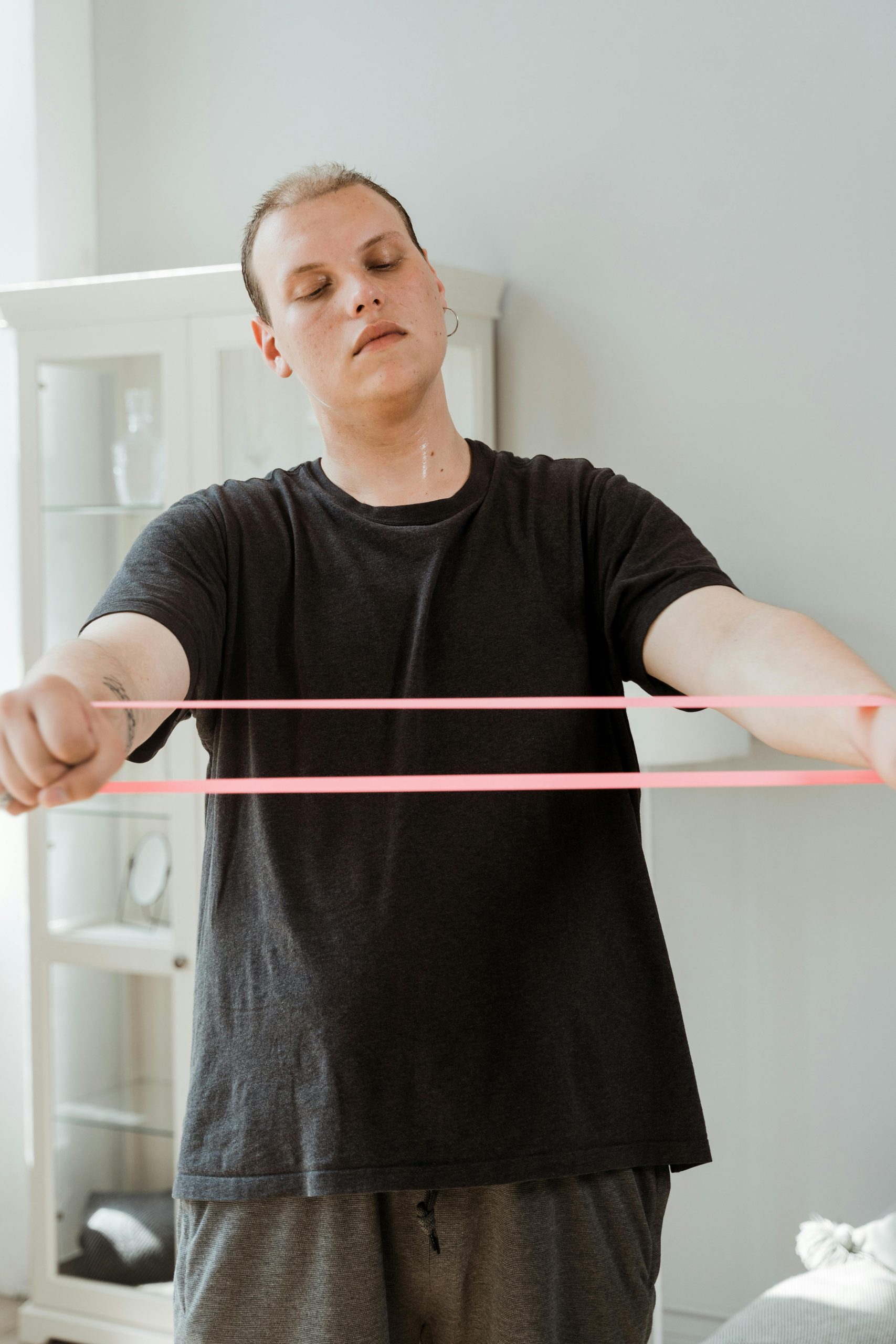
Bed, Chair, Door: How I Turn Any Hotel Room Into a Safe Resistance Band Gym. I know the feeling. You land late, drag your bag into the hotel room, and your body feels stiff from flights, meetings, and airport food.
You want a quick full-body strength training reset, not a long gym session or a noisy workout that wakes your neighbors.
That is where resistance bands with handles and basic hotel furniture come in. With innovative, safe use of the bed, chair, and door, I can get a solid 10 to 15-minute travel workout without leaving the room or risking damage to the hotel.
In this guide, I will walk you through how I check each piece of furniture, set up safe anchor points, and perform the exact moves I use. This training style pairs well with short routines for exercise while traveling, such as my 15-minute travel plan in Simple Workouts for Busy Professionals.
For a quick visual idea of this style of training, this video is helpful:
Table of Contents
Key Takeaways
- Hotel furniture is not gym equipment; even with the portability of resistance bands, a fast safety check matters more than the resistance training itself.
- I use the bed mainly for support, not as a strong anchor for heavy pulling.
- The chair is my mini gym, great for rows, presses, and lower-body work.
- The door is the strongest anchor, but only when tested and set up correctly.
- With a simple 15-minute hotel room workout routine, I can train hard, stay safe, and still sleep well.
Turn Any Hotel Room Into a Safe Resistance Band Gym (Step-by-Step Setup)
When I train in a hotel, my first rule is simple: safety first, workout second. The hotel furniture looks solid, but it is not designed to withstand strong pulling or heavy tension from bands.
I treat the first minute in the room as a “pre-flight check.” It is not fancy. It is just a few fast tests that keep me from slipping, snapping a band, or paying for damage at checkout.
Safe resistance band exercises recommended by the American Council on Exercise.
Quick Safety Checklist for Any Hotel Room
Here is the short list I run through before I touch a band:
- Floor check
I make sure the floor where I will train is dry and clear—no wet spots, no loose towels, and no rolling suitcase in the way. - Space check
I stand in the minimal space where I will train and swing my arms slowly to the front, sides, and up. If I hit a lamp, TV, or wall, I move. - Band check
I run my fingers along the band, looking for cracks, thin spots, or cuts. If a band looks old or rough, I skip it. - Ceiling and light check
For overhead moves, I check ceiling height and light fixtures. If the ceiling is low or there is a hanging light, I keep moving chest-height or lower.
Those 10 to 20 seconds save me from most problems before they start.
How to safely use resistance bands for strength training
How I Test Furniture So It Does Not Move or Tip
Next, I test the furniture as if I were trying to “break” it without a band attached.
For the bed:
- I press down hard on the edge, then sit and bounce gently.
- If the bed has wheels, I see if it rolls when I push with my hips. If it moves, I use it for lying work, not for strong pulling.
For the chair:
- I pick the most stable one I can find: four solid legs, no wheels if possible.
- I sit, rock my weight from side to side, then grab the backrest and pull and push.
- If it wobbles or feels weak, I only use it as light balance support, not as a band anchor.
For the door:
- I choose the heavy main room door, never a thin bathroom or sliding closet door.
- I close it entirely and check that it latches or locks.
- I pull on the handle from the inside to feel how solid the frame is.
I always avoid loose headboards, wobbly chairs, glass desks, and sliding doors. Those are problems waiting to happen.
Band Safety: Anchors, Angles, and Your Body Position
Resistance bands are simple, but the angle of pull can change the force on your joints because of their variable resistance.
Here is how I keep things safe:
- I start with a lighter band and higher reps. I only move to a stronger band once the setup feels rock solid.
- I line my joints up. For example, during a row, I keep my wrists, elbows, and shoulders in a smooth line and avoid twisting under tension.
- I pay attention to angles. If the resistance band pulls up from a low anchor, I tilt my body so my spine stays neutral, not bent.
My personal rule: if the resistance band rubs against a sharp edge, a door corner, or a metal part, I change the setup. I would rather move to a new spot than risk a snapped band.
I also like to prioritize training consistency with short, innovative workouts rather than long, messy ones. If you want a simpler structure like this, I share weekly ideas in my Fit With Greg newsletter.
How I Use the Bed for Safe Seated and Lying Band Exercises
I think of the hotel bed as a soft training bench. It supports my body, takes pressure off my joints, and feels nice after a long flight.
I do not use the bed frame as a primary anchor for heavy pulls. Most hotel beds are not built for that. Instead, I let the bed hold my back, hips, or head while the band anchors to my feet or hands.
On softer mattresses, balance can feel strange. When that happens, I move closer to the edge or plant my feet on the floor for more control.
Best Bed Positions for Resistance Band Exercises: Core, Glutes, and Upper Back
Here are a few of my go-to bed moves:
1. Glute bridge with a band
- I lie on my back with my feet on the floor and the top of my back on the bed edge.
- I looped resistance bands above my knees and pressed them gently outward.
- I squeeze my glutes and lift my hips, hold for a second, then lower with control.
2. Dead bug for the core
- I lie on my back on the bed, knees over hips.
- I hold the band in my hands over my chest, with light tension.
- I slowly lower one leg and the opposite arm, keep my back flat for core engagement, then switch sides.
3. Seated band rows
- I sit near the edge of the bed and loop the resistance band around my feet.
- I sit tall, chest proud, and row the handles toward my ribs.
- I squeeze the shoulder blades together, then return slowly.
On a soft bed, I move more slowly and keep my spine neutral, not rounded. That keeps the work in the muscles rather than the joints.
Bed Moves I Avoid So I Do Not Strain My Back or Neck
I skip anything that turns the bed into a trampoline. For example:
- Fast band sit-ups on a soft mattress
- Heavy leg lifts with a strong band that pulls on my lower back
- Explosive hip thrusts that make the bed shift or squeak
Those moves add stress to the neck and back, which are already tight from travel. I stick with slow, controlled breathing, slow tension, and support from the floor when needed.
How I Turn a Hotel Chair Into a Safe Mini Gym
If I had to pick only one piece of hotel furniture to train with, I would choose the chair. It gives me a stable seat, a backrest for support, and a handle for balance.
With a band and a solid chair, I can hit upper- and lower-body moves, and even full-body combos, in a tiny space. This style works well at home too, and it fits right into a small-space fitness guide for time-pressed people.
Choosing and Testing the Right Chair in Your Room
My ideal hotel chair has:
- Four sturdy legs
- No wheels
- A firm seat and backrest
If the only chair has wheels, I push it tight against the wall so it cannot roll.
I test it like this:
- Sit down and rock gently forward and back.
- Press down into the seat like you are doing a heavy dip.
- Grab the top of the backrest and pull toward you.
If anything creaks, slides, or tilts, I treat the chair only as light balance support during squats or split squats.
Upper Body Exercises With Bands and a Chair
Some of my favorite chair moves using resistance bands with handles are simple but effective.
Seated bent-over rows
- Sit tall at the front of the chair.
- Loop the band around your feet.
- Row the handles toward your ribs, elbows close, shoulders down.
Seated overhead press
- Sit with feet flat, band under your hips or feet.
- Hold the handles at shoulder height.
- Press straight up without arching your lower back.
Face pulls (only with a sturdy chair)
- Wrap the band around the back of the chair at face height.
- Sit or kneel, and pull the band toward your nose with your elbows high.
- Focus on the rear shoulders and upper back.
In every move, I think “long spine, light grip, slow return.”
Lower Body and Glute Exercises Using the Chair for Balance
Long flights and meetings make my hips and legs tight. Chair-based moves help wake them up.
Here is what I use often:
- Banded squats to the chair: Band around thighs, tap the chair with your hips, then stand.
- Banded lateral walks: Band around ankles or knees, light hand on the chair for balance as you step side to side.
- Single-leg sit-to-stand: Light resistance band for resistance, one foot on the floor, stand up slowly, and sit down with control.
These moves fit easily into a 10- to 15-minute routine and make little noise, keeping hotel neighbors happy.
How to Safely Use the Hotel Door as a Band Anchor
The door is often the strongest anchor in the room, so I treat it with extra care. A sloppy setup can send a resistance band flying back at your face.
When I take my time with the door anchor, I get smooth rows, presses, and pulldowns without leaving the room.
Door Safety: Which Doors I Trust and How I Test Them
Here is my door rule: main room door only.
I skip:
- Bathroom doors
- Sliding closet doors
- Thin connecting doors
My steps:
- Close the main door and lock or latch it.
- Use a proper door anchor if I have one, placed on the hinge side or at the top.
- Stand on the side where the door closes toward my body, not away from it.
After I set the band or anchor, I do a “pull then push” test with light force. I pull the band, then try to push the door open a little. If the door moves at all, I reset the anchor or skip the door for that session.
Safe Door Anchor Placement for Common Band Exercises
I keep anchor spots simple:
- Top of the door: Lat pulldowns and triceps pressdowns
- Middle of the door (chest height): Rows and chest presses
- Bottom of the door: Biceps curls and kickbacks for glutes
The door stays fully shut with the security lock set when I can. I never stand in line with the band snap point. I angle my body slightly so if the band slips, it does not hit my face.
Upper and Lower Body Moves I Do With a Door Anchor
Here is a small menu of resistance band exercises I rotate through to target major muscle groups:
- Chest press: Anchor at chest height, face away from the door, press handles forward.
- Rows: Anchor at chest height, face the door, pull handles to the ribs.
- Lat pulldown: Anchor at the top, kneel or stand, pull from overhead to chest.
- Triceps pressdown or kickbacks: Anchor at top, elbows at sides, extend arms straight.
- Bicep curl: Anchor low, face the door, curl handles toward shoulders.
- Glute kickbacks: Anchor low behind you, strap the band around one ankle, and extend the leg back.
I step out just far enough to keep tension, but not so far that I jerk the door or lose balance.
Putting It All Together: A Simple 15 Minute Hotel Band Workout
Once I know the room is safe, I like to run one simple 15-minute circuit. It is quiet, low on gear, and easy to repeat in any city.
You can pair this with other short plans, like my 15-minute workouts for busy professionals, for more variety when you travel.
Warm Up in 3 Minutes With No Noise and No Equipment
I keep my warm-up smooth and quiet:
- 45 seconds of marching in place with soft foot strikes
- 30 seconds of arm circles forward, then 30 seconds backward
- 30 seconds of hip circles
- 30 seconds of light bodyweight squats
- 30 seconds of ankle rolls on each side
I breathe through my nose when I can and focus on bigger, smoother motion rather than speed.
Complete Body Circuit Using Bed, Chair, and Door
Here is a simple, repeatable full-body workout routine: 2-3 rounds. Perform sets and repetitions with about 40 seconds of work, 20 seconds of rest, then move to the next move.
- Bed glute bridge with band
- Seated band row on the chair
- Chair-supported banded squat
- Door-anchored chest press
- Door-anchored lat pulldown or row to train the upper body
If I have more time, I add a sixth move, such as banded lateral walks or lower-body lunges, while holding the chair for balance.
I keep my form clean, my breath steady, and my focus on smooth control rather than chasing fatigue in this powerful full-body session. That way, I can still perform at meetings the next day.
Cool Down and Stretching So You Sleep Better After Travel
To finish, I use the band for light stretching:
- Gentle chest stretch by holding the band behind my back
- Shoulder stretch by holding the band overhead and slowly widening my grip
- Hip flexor stretch with one knee on the bed or floor
- Hamstring stretch by looping the band around one foot while lying on the bed
Each stretch lasts about 20 to 30 seconds. I breathe slowly and let my heart rate come down. Building this kind of simple, repeatable routine is much easier when I keep fresh ideas coming, which is why I share hotel-friendly tips in my Fit With Greg newsletter.
FAQs: Turning Any Hotel Room Into a Safe Resistance Band Gym
How can I get a real full-body workout with just resistance bands in a hotel room?
I treat bands like a portable cable machine. I hit all the main movement patterns: push, pull, hinge, squat, and carry or core.
A simple full-body structure I use is:
- Upper push: chest press or push-up with a band
- Upper pull: row or band pulldown anchored in the door
- Legs: squats, split squats, or hip hinges with the band under my feet
- Glutes and hamstrings: band deadlifts or hip thrusts
- Core: anti-rotation holds, band chops, or dead bugs
If I work through each pattern for 2 to 4 sets of 8 to 15 reps, I get a solid session without going to the hotel gym.
How can I get a real full-body workout with just resistance bands in a hotel room?
I treat bands like a portable cable machine. I hit all the main movement patterns: push, pull, hinge, squat, and carry or core.
A simple full-body structure I use is:
What kind of resistance bands should I pack for hotel workouts?
I like a small “travel kit” that covers most exercises without taking up space. My go-to setup:
| Band Type | What I Use It For | Why I Pack It |
|---|---|---|
| Long loop bands | Rows, deadlifts, presses, assisted pull-ups | Most versatile, great for strong guys |
| Tube bands with handles | Chest press, rows, curls, triceps | Comfortable grip, easy on joints |
| Small loop (mini) bands | Glute work, warm-ups, shoulder activation | Tiny, perfect for quick add-ons |
| Door anchor | Rows, face pulls, pulldowns, presses | Turns any door into a cable station |
For most men over 30, I like:
- One light band (mobility, warm-up, shoulders)
- One medium band (upper body work)
- One heavy band (legs, deadlifts, rows)
That covers almost anything I want to do while I travel.
What kind of resistance bands should I pack for hotel workouts?
I like a small “travel kit” that covers most exercises without taking up space. My go-to setup:
How do I anchor resistance bands safely in a hotel room without damaging anything?
I keep it simple and careful.
What I do:
- Use a proper door anchor: I place it on the hinge side of the door, then fully close and lock the door. That way, it cannot fly open.
- Test the setup: I pull lightly first to make sure the anchor is secure, and the door does not move.
- Use solid anchor points: Door anchors, sturdy table legs, or heavy bed frames work. I avoid loose furniture or lamps.
- Protect surfaces: If I loop a band around a post or bed frame, I place a towel between the band and the surface to prevent scratching.
I never anchor bands to fire sprinklers, door handles, or anything that looks weak or important for safety.
How do I anchor resistance bands safely in a hotel room without damaging anything?
Keep it simple and careful.
What I do:
Use a proper door anchor: I place it on the hinge side of the door, then fully close and lock the door. That way, it cannot fly open.
Test the setup: I pull lightly first to make sure the anchor is secure, and the door does not move.
Use solid anchor points: Door anchors, sturdy table legs, or heavy bed frames work. I avoid loose furniture or lamps.
Protect surfaces: If I loop a band around a post or bed frame, I place a towel between the band and the surface to prevent scratching.
I never anchor bands to fire sprinklers, door handles, or anything that looks weak or important for safety.
How much space do I really need for a hotel room resistance band workout?
I aim for enough room to lie down flat on my back without hitting furniture. If I can do that, I can train.
For most band workouts, I only need:
- About a yoga-mat-sized floor space
- A solid door for anchoring
- A small area at the side or foot of the bed
If the room is tiny, I shift the desk chair, small tables, or bench to create a mini training zone.
How much space do I really need for a hotel room resistance band workout?
I aim for enough room to lie down flat on my back without hitting furniture. If I can do that, I can train.
For most band workouts, I only need:
About a yoga-mat-sized floor space
A solid door for anchoring
A small area at the side or foot of the bed
If the room is tiny, I shift the desk chair, small tables, or bench to create a mini training zone.
Can I actually build or maintain muscle with resistance bands while traveling?
I can, as long as I treat band work like regular strength training. The keys for me are:
- Progressive tension: I pick a band that makes the last 2 to 3 reps feel hard while maintaining form.
- Enough volume: Usually 8 to 15 reps per set, 2 to 4 sets per exercise.
- Short rest: About 45 to 75 seconds between sets keeps sessions efficient.
If I am on the road for a week or two, bands help me maintain muscle and strength. With smart programming and heavier bands, I can still make progress, especially on higher-rep work and weak points like shoulders, glutes, and upper back.
Can I actually build or maintain muscle with resistance bands while traveling?
I can, as long as I treat band work like regular strength training. The keys for me are:
Progressive tension: I pick a band that makes the last 2 to 3 reps feel hard while maintaining form.
Enough volume: Usually 8 to 15 reps per set, 2 to 4 sets per exercise.
Short rest: About 45 to 75 seconds between sets keeps sessions efficient.
If I am on the road for a week or two, bands help me maintain muscle and strength. With smart programming and heavier bands, I can still make progress, especially on higher-rep work and weak points like shoulders, glutes, and upper back.
What’s a simple hotel-room resistance-band workout I can do on busy days?
I like a fast “hotel full-body” session; I can finish in 20 to 25 minutes. For example:
A. Lower body
- Band squats or split squats, 3 sets of 10 to 15 reps
B. Push
- Band chest press (anchored in the door at chest height), three sets of 8 to 12 reps
C. Pull
- Band row (door anchor at chest or waist height), three sets of 10 to 15 reps
D. Hips and glutes
- Band deadlifts or hip thrusts, three sets of 10 to 15 reps
E. Core
- Anti-rotation hold or band chop, 2 to 3 sets of 20 to 30 seconds per side
I rest only long enough to keep good form, then move on.
What’s a simple hotel-room resistance-band workout I can do on busy days?
I like a fast “hotel full-body” session; I can finish in 20 to 25 minutes. For example:
A. Lower body
Band squats or split squats, 3 sets of 10 to 15 reps
B. Push
Band chest press (anchored in the door at chest height), three sets of 8 to 12 reps
C. Pull
Band row (door anchor at chest or waist height), three sets of 10 to 15 reps
D. Hips and glutes
Band deadlifts or hip thrusts, three sets of 10 to 15 reps
E. Core
Anti-rotation hold or band chop, 2 to 3 sets of 20 to 30 seconds per side.
I rest only long enough to keep good form, then move on.
How do I keep hotel band workouts quiet so I don’t bother neighbors?
I train like someone is sleeping next door.
- Skip jumping or stomping movements
- Control the band on the way back, no snapping at the end of the range
- Avoid dropping my body weight fast on the floor
- Place a towel or mat down to soften contact and reduce noise
Most band work is naturally low-impact and quiet, so if I move with control and avoid high-impact cardio, I am usually fine.
How do I keep hotel band workouts quiet so I don’t bother neighbors?
I train like someone is sleeping next door:
Skip jumping or stomping movements.
Control the band on the way back, no snapping at the end of the range.
Avoid dropping my body weight fast on the floor.
Place a towel or mat down to soften contact and reduce noise.
Most band work is naturally low-impact and quiet, so if I move with control and avoid high-impact cardio, I am usually fine.
How many days per week should I use resistance bands while I travel?
When I travel, I aim for 3 to 4 days per week of band strength work. That keeps my routine steady.
Simple options:
- 3-day plan: Full-body sessions, non-consecutive days (for example, Monday, Wednesday, Friday)
- 4-day plan: Upper body twice, lower body twice, with at least one rest day
If travel is hectic, I might do two full-body band sessions plus short mobility or core work on off days.
How many days per week should I use resistance bands while I travel?
When I travel, I aim for 3 to 4 days per week of band strength work. That keeps my routine steady.
Simple options:
3-day plan: Full-body sessions, non-consecutive days (for example, Monday, Wednesday, Friday)
4-day plan: Upper body twice, lower body twice, with at least one rest day.
If travel is hectic, I might do two full-body band sessions plus short mobility or core work on off days.
How do I stay safe and avoid injury when using bands in a hotel room?
I treat bands with the same respect as weights. My basic rules:
- Inspect bands first: If I see cracks, thinning, or fraying, I skip that band.
- Warm up: I spend 3 to 5 minutes on light band pull-aparts, shoulder circles, and bodyweight squats.
- Control each rep: No jerking or fast bouncing at the end of the range.
- Keep bands away from my face: I avoid positions where a slip would snap toward my eyes.
- Use the right difficulty: If I am twisting or losing form, I drop to a lighter band.
If a movement hurts sharply or feels odd, I adjust the angle, use a lighter band, or choose a different exercise.
How do I stay safe and avoid injury when using bands in a hotel room?
I treat bands with the same respect as weights. My basic rules:
Inspect bands first: If I see cracks, thinning, or fraying, I skip that band.
Warm up: I spend 3 to 5 minutes on light band pull-aparts, shoulder circles, and bodyweight squats.
Control each rep: No jerking or fast bouncing at the end of the range.
Keep bands away from my face: I avoid positions where a slip would snap toward my eyes.
Use the right difficulty: If I am twisting or losing form, I drop to a lighter band.
If a movement hurts sharply or feels odd, I adjust the angle, use a lighter band, or choose a different exercise.
What’s the best way to pack and organize resistance bands in my luggage?
I keep my bands in a small drawstring bag so they do not tangle or mark clothes.
- Coil each band loosely, not too tight, to avoid kinks
- Put metal clips and door anchors in a side pocket so they do not scratch anything
- Pack bands in my carry-on if I want a workout during delays or at the airport hotel
Bands weigh very little, so I can carry several without significantly increasing my luggage weight.
What’s the best way to pack and organize resistance bands in my luggage?
I keep my bands in a small drawstring bag so they do not tangle or mark clothes.
Coil each band loosely, not too tight, to avoid kinks
Put metal clips and door anchors in a side pocket so they do not scratch anything
Pack bands in my carry-on if I want to work out during delays or at the airport hotel.
Bands weigh very little, so I can carry several without significantly increasing my luggage weight.
How long should a hotel room resistance band workout take?
Most of my hotel sessions last 20 to 40 minutes. That is enough if I stay focused.
I usually aim for:
- 5 minutes, warm-up and activation
- 15 to 30 minutes, strength work
- 2 to 5 minutes, light stretching or breathing to cool down
On a packed work trip, a hard 20-minute band circuit still beats skipping training completely.
How long should a hotel room resistance band workout take?
Most of my hotel sessions last 20 to 40 minutes. That is enough if I stay focused.
I usually aim for:
5 minutes, warm-up and activation
15 to 30 minutes, strength work
2 to 5 minutes, light stretching or breathing to cool down.
On a packed work trip, a hard 20-minute band circuit still beats skipping training completely.
Conclusion
With a quick safety check and innovative use of the bed, chair, and door, I can turn almost any hotel room into a safe mini gym using only resistance bands. I do not need a full hotel fitness center to stay strong, mobile, and clear-headed on the road.
Even 10 to 15 focused minutes of exercise while traveling can keep your joints happy and your energy high between flights and meetings. Save this outline, test your hotel room the next time you travel, and run the simple circuit.
If you want more short, practical routines built for busy professionals, my 15-minute travel plan and weekly newsletter are both significant next steps. The goal is simple: stay strong, stay safe, and make every trip a little easier on your body.