
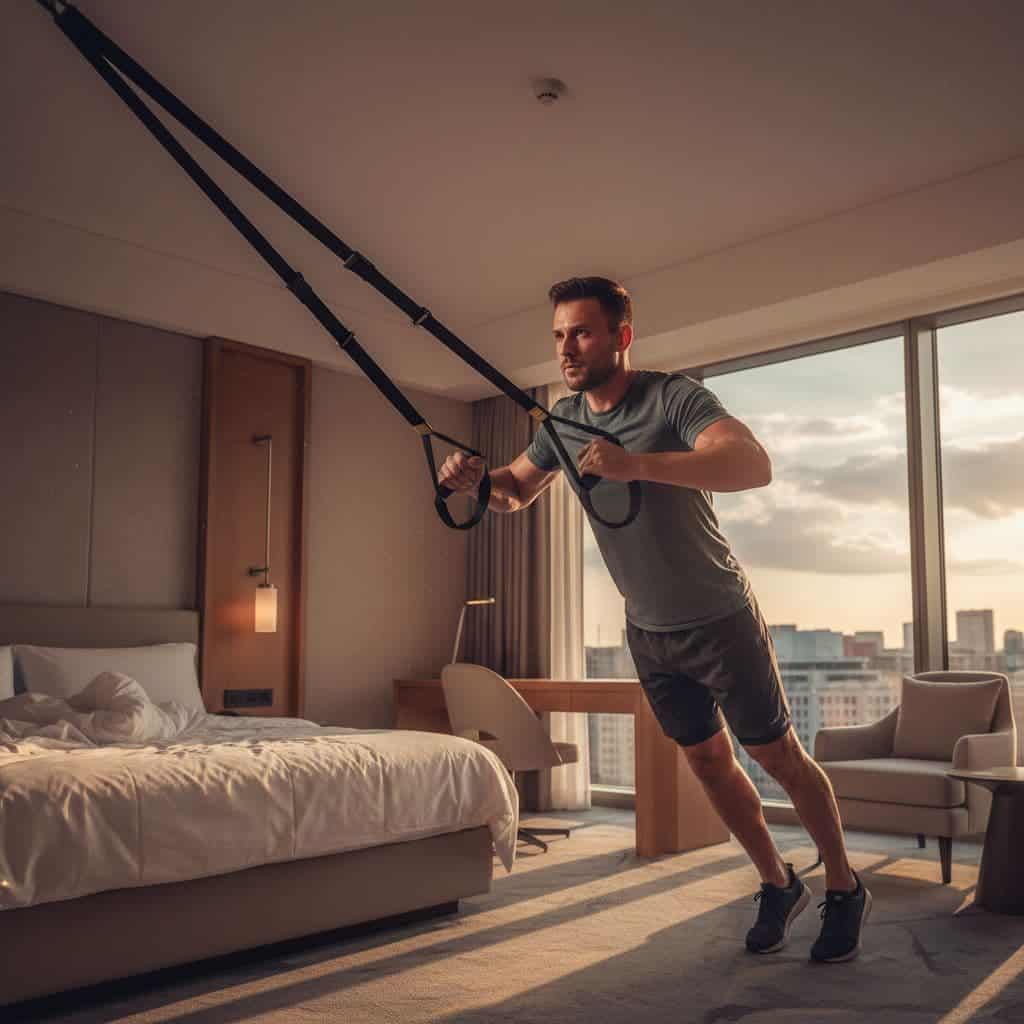
TRX Hotel Room Workout: My Go-To Full-Body Plan for Travel Days. I’ve had plenty of trips where the schedule is tight, the gym is closed (or sketchy), and I still want to stay fit while traveling before the day starts. On those mornings, a TRX hotel workout is my easiest win.
The TRX Go system works so well for adults 30-plus because it easily fits in carry-on luggage, it’s adjustable, joint-friendly, and full-body without needing heavy weights. I can dial the intensity up or down just by changing my body angle, and I can keep every rep controlled and quiet.
In this post, I’ll walk you through how I set it up safely, a simple 20-minute full-body workout that fits most rooms, and how I scale it for fat loss, strength, or just staying pain-free. If you prefer shorter sessions, this approach fits neatly with my simple 15-minute plan for business travelers.
Key Takeaways
- A suspension trainer setup like TRX can be safe in a hotel room if you anchor on the hinge side and the door opens away from you.
- Intensity comes from body angle, tempo, and range, not fancy moves.
- My 20-minute hotel room workout plan is low impact, quiet, and repeatable (warm-up, two circuits, and an optional finisher) to help you crush your fitness goals.
- If anything feels unstable, I switch to bodyweight options and move on.
Table of Contents
How I set up a TRX in a hotel room safely (no damage, no drama)
Safety comes first, because the goal is to train, not to rip a door open or end up on the floor. Most hotel rooms can work fine, but only if the hotel door setup is solid.
Here’s the anchor method I use most often:
- I anchor over the top of the door.
- I place the anchor on the hinge side for a secure anchor point, not the handle side.
- I make sure the door opens away from me, so my bodyweight pulls the door into the frame, not out of it.
I also pay attention to the hotel door itself. If it looks hollow, warped, loose in the frame, or the latch plate is wobbly, I don’t force it. Some hotel doors feel rock-solid; others feel like cardboard.
For a door anchor, I keep it simple. Something like a door mount on Amazon is the style I’m talking about (small, light, easy to pack). I’m not picky about brands; I’m fussy about stability.
Door and strap basics, I always follow.
I set the TRX straps’ length so the handles hang evenly and don’t twist. For most moves, mid-length is fine. For planks and hamstring work, I shorten them.
If I’m worried about scuffing the door, I fold a small towel and place it between the TRX straps and the top edge of the hotel door. It’s a tiny step that can save you from weird damage fees.
If the door setup feels unsafe, I don’t negotiate with it. I’ll do one of these instead:
- Use a sturdy post or column if the room has one (rare, but it happens).
- Skip aggressive leaning moves (like steep chest presses) and do more upright rows and squats.
- Do bodyweight exercises for the day and use the TRX only for gentle support.
For extra ideas on travel-friendly TRX training, I’ve also picked up a few practical cues from this 24 Hour Fitness travel post: https://www.24hourfitness.com/24life/fitness/2019/traveling-take-your-trx-workout-with-you
My 60-second safety checklist before I start
I run this fast list every time, even if I’m tired:
- The door closes fully, and the latch is engaged
- The anchor is on the hinge side
- The door opens away from me
- Floor isn’t slippery (no socks on shiny tile)
- I have enough space behind me to lean back
- Straps are even, handles match
- I do a hard two-hand pull test before my first set
If anything shifts, pops, or makes loud noises, I stop right away and reset. No stubborn reps.
What to pack with my TRX to make hotel workouts easier
I like minimal gear, because suitcase space is always limited.
Mini band: Great for glute activation and warm-ups, especially if I’m sitting a lot on flights.
Light loop band: Helps with shoulder work, and it’s an easy backup if the TRX setup isn’t ideal.
Small towel (or travel mat towel): Protects the door, and it’s nice for kneeling planks.
Timer app: Makes the workout feel automatic, especially on low-motivation days.
Jump rope (optional): A travel-friendly choice only if I know the room has space and the floors aren’t thin, which is rare.
My 20-minute TRX hotel room workout (whole body, low impact)
This is the hotel room workout routine I repeat most often on the road. It’s simple, quiet, and it hits different muscle groups through the main patterns: push, pull, squat, hinge, lunge, and core.
Here’s the structure:
PartTimeWhat I’m doingWarm-up3 minutesLoosen hips, shoulders, coreCircuit A8 minutesPush, pull, legs, plankCircuit B8 minutesGlutes, posture, coreOptional finisher2 minutesShort sweat without jumping
How I choose reps: I work in the 8-12 rep range for strength and control. If I’m short on time, I use 30-40 seconds per move instead.
How I adjust intensity: The closer my feet are to the anchor (more lean), the harder it gets. Slower reps with a controlled range of motion also make a huge difference, especially for joints.
Warm up in 3 minutes (I loosen hips, shoulders, and core)
I don’t try to “crush” the warm-up. I want my joints to feel ready for mobility and strength, and my breathing to settle.
- March in place with arm swings (30 seconds)
- Hip hinge practice, hands on hips, slow reps (6 to 8 reps)
- Shoulder circles (20 seconds each direction)
- Thoracic twists, gentle, no yanking (6 each side)
- Squat to stand, slow, breathe out as I stand (5 reps)
If I’m stiff from travel, I take smaller ranges at first. Warm-ups should feel better as they go, not worse.
Circuit A: Push, pull, and legs (repeat 2 times)
I do each move for 8 to 12 reps, resting 30 to 45 seconds between moves as needed. If the day is hectic, I go time-based and do 35 seconds on, 25 seconds off. This covers upper-body movements like push and pull, alongside lower-body movements such as TRX squats.
1) TRX chest press
I face away from the anchor and do the chest press like a standing push-up.
Beginner: Stand more upright and keep elbows closer to my sides.
Harder: Walk feet back, lean more, add a 2-second pause at the bottom of the chest press.
2) TRX row
I face the anchor, squeeze my shoulder blades first, then row.
Beginner: More upright, smaller lean, slower pull.
Harder: More lean, 3-second lowering phase, full stop at the bottom.
3) TRX squats (or assisted split squat)
TRX squats are my default, because they’re quiet and fit any room.
Beginner: Use the straps for balance; sit back; stop before the knees complain.
Harder: Slow down (3 seconds down), add a 1-second pause at the bottom.
If squats bug my knees, I switch to assisted split squats and keep the range small.
4) TRX plank (forearms or hands)
I keep ribs down and glutes on in the plank position, like I’m bracing for a light punch to build core stability.
Beginner: Hands on bed or desk for an incline plank.
Harder: Feet in foot cradles for a long-lever plank, only if the setup is rock solid.
Quick cue that saves me every time: if my shoulders creep up toward my ears, I reset and pull them down and back.
Circuit B: Glutes, core, and posture (repeat 2 times)
This circuit is where I clean up my posture after sitting and carrying bags. I want glutes, mid-back, and abs working together.
1) TRX hip hinge (or hamstring curl)
Hip hinge option (easy setup): I face the anchor, hold the straps, push my hips back, and stand tall.
Hamstring curl option (harder): Heels in straps, curl with hips lifted.
What I should feel: hamstrings and glutes, not low-back strain.
Common mistake: letting ribs flare and over-arching the back.
2) TRX reverse lunge (assisted TRX lunges)
I hold the straps lightly and step back under control.
Beginner: Shorter step, smaller depth, keep the front foot planted.
Harder: Add a 2-second pause at the bottom, stay tall.
3) TRX face pull (or Y raise)
Face pulls hit my upper back and help my shoulders feel “open.”
Beginner: Face pull with elbows slightly down, light lean.
Harder: Y raise with straight arms, slow and strict.
What I should feel: mid-back, rear shoulders, not neck tension.
4) TRX dead bug (or body saw)
Dead bug version: I’m on my back, straps in hands, slow lower and brace.
Body saw version: Plank with feet in straps, shift forward and back a few inches.
Common mistake: moving too far and losing core control.
For extra movement ideas that travel well, this SELF guide has a solid list of TRX options: https://www.self.com/sponsored/story/12-do-anywhere-trx-moves-that-will-keep-you-fit-on-the-go.
Optional 2-minute finisher when I want a sweat (quiet and hotel-friendly)
If I’ve got energy, I keep this short so I don’t turn it into chaos.
I use 20 seconds work, 10 seconds rest, four rounds (2 minutes total). Pick one of these bodyweight exercises:
- Fast (controlled) TRX rows
- Squat pulses while holding straps
- Slow mountain climbers (hands on floor or bed)
- Plank shoulder taps, feet wide, quiet hips
The rule is simple: stay controlled and quiet. If I’m stomping around, I’m doing it wrong.
How I scale this TRX hotel room workout for my goals (fat loss, strength, and staying pain-free)
When I travel, I don’t chase perfect workouts. I chase repeatable ones. Progress on the road comes from small changes that don’t beat up my joints.
The three dials I adjust
Body angle: A more lean from the anchor point equals more load. This is my main lever.
Tempo: Slower lowers, pauses, and smooth reps make light training feel heavy.
Volume: Extra round, shorter rest, or one extra set if I feel good.
If fat loss is the goal, I keep rest shorter and add the 2-minute finisher. If strength is the goal, I slow reps and take longer rests so form stays crisp.
A helpful reminder for anyone 30-plus: consistent resistance training matters more with age, and it doesn’t need to be extreme to pay off. I like this perspective from a coach who focuses on older athletes: https://trainright.com/strength-training-trx-workout-cts/
A simple weekly template for travelers
This is what I actually do when I’m on the move with the suspension trainer:
- 2 sessions per week: One Circuit A and B workout, repeat later in the week.
- 3 sessions per week: Full workout twice, plus one short session (just Circuit A).
- 4 sessions per week: Two full workouts, two short workouts (pick four moves, 12 minutes).
On off days, I walk. Walking fixes stiffness fast, and it helps me sleep.
If you want more travel-friendly workouts like this, I send them out in my weekly fitness newsletter.
My simple progression rules (so I do not overdo it on the road)
I stick to these rules so I don’t wreck myself mid-trip:
- Leave 1 to 2 reps in reserve on most sets.
- Stop if I feel joint pain (muscle burn is fine, sharp pain isn’t).
- Change one thing at a time (more lean or slower tempo, not both).
- Keep reps smooth, no sloppy “travel ego” lifting.
- Match effort to sleep and stress (inadequate sleep equals lighter session).
- After long trips, I take a lighter week to reset.
Common mistakes I avoid in hotel TRX sessions
I’ve made all of these mistakes, and they’re easy to fix once you notice them.
Leaning too far too soon: I start more upright, then increase the angle.
Shrugging on rows: I pull my shoulder blades down first, then row.
Over-arching on planks: For core stability, I tuck my ribs down and squeeze my glutes.
Knees caving on lower-body squats and lunges: I press the knees gently out and slow down.
Rushing reps: I count a 2 to 3-second lower on most moves.
Skipping the tug test: I always test the anchor point hard before I trust it.
Slippery sock training: I wear shoes or go barefoot if the floor is slick. For upper body rows, I avoid shrugging by pulling my shoulder blades down first.
Minor fixes make the workout feel better right away.
Frequently Asked Questions About TRX Hotel Room Workouts (Travel-Friendly Training)
Can I do a full TRX workout in a standard hotel room?
Yes, I can get a solid full-body workout in most hotel rooms. TRX training uses my bodyweight, so I don’t need much space, just enough room to step back from the anchor point and move my arms freely.
If the room is tight, I stick to moves that stay mostly in place (like rows, squats, chest press, planks, and hamstring curls).
What’s the safest way to anchor TRX in a hotel?
I use a door anchor on a sturdy door that closes firmly. I place the anchor on the hinge side (the top of the door), fully close it, and lock it if there’s a lock. Before I put full weight on it, I give the straps a hard tug and do a few slow test reps.
I don’t anchor to towel bars, closet rods, sprinklers, or furniture. Those aren’t built for bodyweight force and can break.
Will TRX damage the hotel door or frame?
If I use the door anchor correctly, it shouldn’t damage anything. I make sure the door is solid, the anchor sits flat, and the straps aren’t rubbing the frame. I also avoid any setup that pinches the straps against sharp edges.
If the door looks flimsy, the frame is loose, or the latch doesn’t catch well, I don’t use that door.
What if my hotel room doesn’t have a good door for anchoring?
I’ve run into this, especially with sliding doors, weak bathroom doors, or doors that don’t fully close. In that case, I switch plans:
- I use the hotel gym if it’s open and quiet
- I do a no-anchor bodyweight workout (squats, lunges, push-ups, glute bridges, planks)
- I bring a light resistance band as a backup
If there’s no safe anchor, I don’t force it.
How long should a TRX hotel room workout be?
Most days on the road, 15 to 30 minutes is plenty. It’s long enough to hit the basics and short enough to fit a busy travel day.
If I’m tired or jet-lagged, I keep it to 10-15 minutes and focus on good form.
What’s a simple TRX hotel room workout I can follow?
Here’s an easy full-body structure I use when I don’t want to overthink it:
Pick five moves, then do 2 to 4 rounds.
- Row
- Chest press
- Squat (or squat to row)
- Reverse lunge (supported with straps)
- Plank (feet in straps if I have space)
I rest just enough to keep my form clean, usually 30 to 60 seconds.
Is TRX suitable for travel if I’m a beginner?
Yes, because I can adjust the difficulty fast. I make moves easier by standing more upright and keeping the straps shorter. I also slow down reps, which helps me stay in control and learn form.
If I’m new, I keep my first sessions simple and skip anything that feels shaky (like pikes).
What should I pack for TRX workouts while traveling?
I keep it light. My core setup is:
- TRX straps
- Door anchor (if it doesn’t come with my straps)
- A small towel (for sweat or to protect surfaces if needed)
I also like having training shoes, but I can do many moves barefoot if the floor is clean and not slippery.
Can I do TRX in a hotel room without disturbing neighbors?
Usually, yes. TRX is quiet if I control the movement. I avoid jumping, slamming my feet down, or letting the straps snap. I also choose smoother exercises (rows, presses, squats, planks) and keep the workout steady.
If the floors are thin, I train earlier in the evening and skip anything that thumps.
Are there any TRX moves I should avoid in a hotel room?
If space is limited or the anchor feels less than perfect, I skip moves that can pull me off balance fast. That often includes:
High-speed reps, big swinging motions, and anything where I’d fall into furniture if I lost control.
When in doubt, I choose slow rows, presses, supported lunges, and planks. They still work.
Conclusion
A solid TRX hotel workout doesn’t need a big room or a long time. I focus on a safe anchor point door setup, two simple circuits, and easy scaling with body angle and tempo. On your next trip, try this hotel room workout once, then repeat it 2 to 3 times that week to stay fit while traveling and notice how much better your body feels during travel days.
Save the routine, and if you want more travel-friendly short plans you can actually stick with, join the newsletter.