
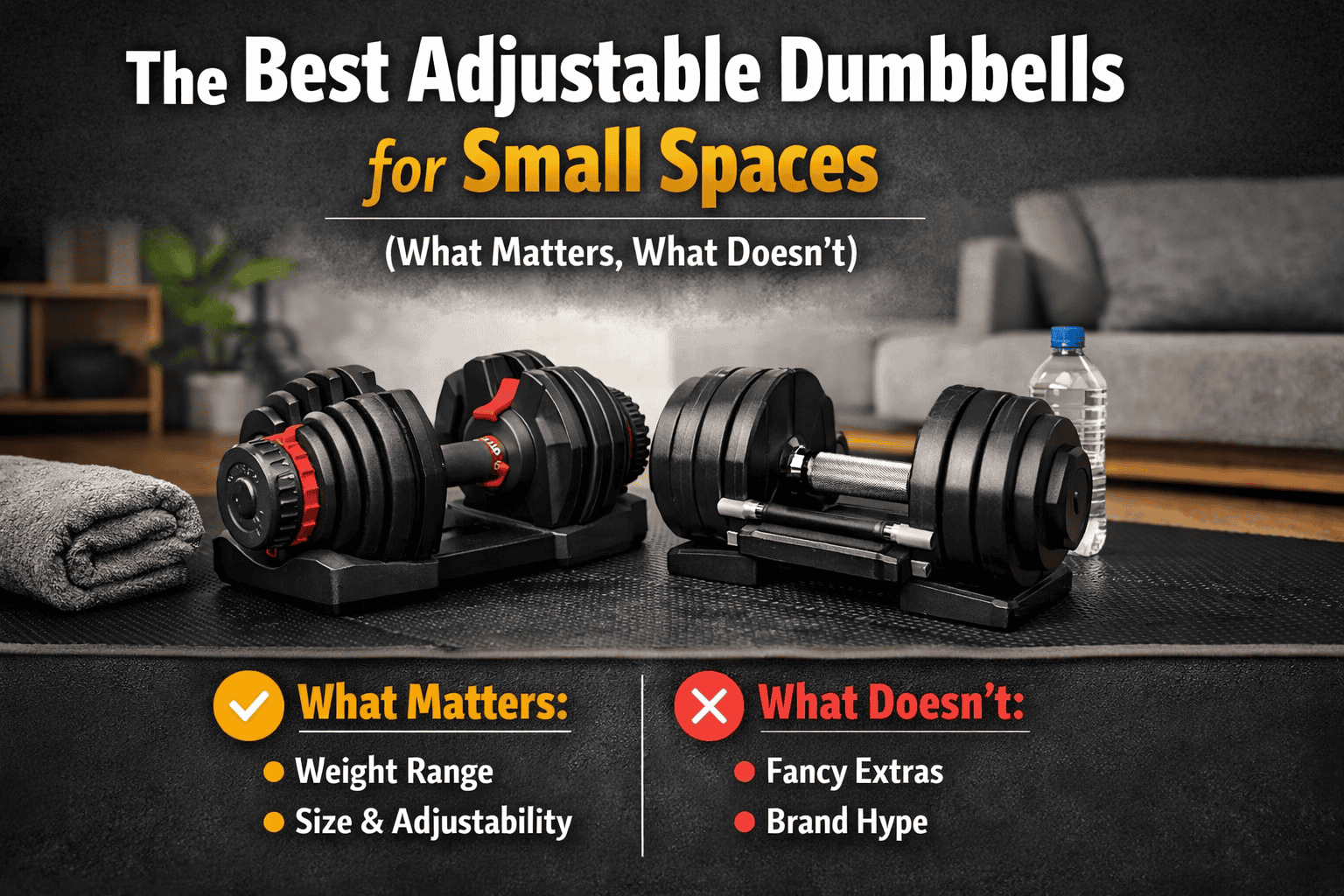
The Best Adjustable Dumbbells for Small Spaces (What Matters, What Doesn’t). If you’ve ever tried to build a home gym in a spare bedroom, studio apartment, or tight corner of a basement, you know the problem.
A full rack of fixed dumbbells is great, but it eats up floor space fast and never seems to fit where you actually train. Check out: 30-minute strength workout with dumbbells only.
This guide breaks down how to pick the best adjustable dumbbells for small spaces, focusing on what matters most for daily use: storage, safety, comfort, and how smoothly your workouts flow. Some popular “features” sound impressive on a product page but won’t help you lift more or train more often, and we’ll call those out too. I
If you want brand ideas and quick comparisons for your home gym, check out this guide to adjustable dumbbells for small rooms.
Key Takeaways
- Measure storage first, then buy. The base and “parking spot” of a compact design matter more than the dumbbell length.
- Weight increments (jump size) affect progress. Smaller jumps often beat a bigger max weight.
- Adjustment mechanism speed changes how likely you are to do supersets, drop sets, and short sessions.
- Handle comfort and balance decide whether the dumbbells feel like tools or like awkward luggage.
- Noise and floor protection matter in apartments, especially if you train early or late.
Table of Contents
What matters most when you live tight on space
Space-saving small-space training isn’t about owning less; it’s about owning gear that doesn’t fight you. Adjustable dumbbells can be perfect for home workouts, but only if the basic specs match your room and your routine.
Before you get distracted by marketing, focus on two things you can test right now: where the adjustable dumbbells will live between sets, and whether the weight options line up with how you actually progress.
Footprint, storage, and how they actually fit in your room
Most people picture “space” as the dumbbell itself. In real life, the space problem is the base, cradle, or stand.
Ask yourself: where will you set them down during a workout? Between sets, you’ll place them on the floor, a mat, a low bench, or back into a cradle. That “parking space” needs to be stable and repeatable.
A few practical checks:
- Measure the storage spot (width, depth, and height). Closet floors, under a desk, or beside a bench all work if you plan for it.
- Plan for clearance. You need room to grab the handle and lift straight up without smashing into a wall or a bed frame.
- Base vs stand:
- A floor base/cradle is usually the smallest and cheapest option, but it sits on the ground. Fine if you’re ok bending down often.
- A vertical stand brings the handles up to waist height, which can feel better on your back and keeps the area tidy. It takes a bit more vertical space and can be less “hideable” in a closet.
If your gym is also your office, choose a setup that slides out of the way. Think “shoebox footprint,” not “cool-looking display.”
Weight range, jump size, and why smaller jumps feel better
Max weight is the headline spec in the weight range, but jump size is the spec you feel every week.
Unlike fixed dumbbells that require owning multiple pairs, adjustable sets let you progress efficiently. If a dumbbell only changes in 5-pound steps, some lifts stall sooner than they need to. That’s common on shoulder work, curls, lateral raises, and triceps moves.
A 5-pound jump can be a huge percentage change when you’re working with lighter loads. Smaller weight increments, like 2.5 pounds, often let you apply progressive overload without breaking form.
A simple rule of thumb for max weight:
- New lifter or general strength training: 50 to 55 pounds per dumbbell covers a lot.
- Hypertrophy focus (most home gym lifters): 50-70 pounds is a sweet spot.
- Couples sharing: prioritize more increments and ease of use over extreme max weight.
- Strong lifter who rows and squats heavy: consider 80 to 100 pounds, but only if you’ll actually use it weekly.
If you’re unsure, pick a max weight you can grow into over 6 to 18 months, not a number that looks tough on the box. For broader comparisons, it can help to skim a tested roundup like Garage Gym Reviews adjustable dumbbell picks.
The features that change your workout every day
Two adjustable dumbbells can have the same weight range and still feel totally different. The difference shows up in daily friction: how fast you change weights, how steady they feel overhead, and whether they rattle like a toolbox.
The three common design types, each with a distinct adjustment mechanism:
- Dial/twist systems: fast changes, usually a classic dumbbell feel, sometimes bigger jumps.
- Pin selector systems (using a selector pin): fast changes, compact storage, can feel boxy or wide.
- Plate-loaded adjustables: very flexible and often quieter when handled well due to solid metal construction, but slower to change with weight plates.
Adjustment speed and workflow between sets
If your workouts are 25 to 40 minutes, adjusting speed is not a luxury. It’s the difference between doing the set you planned and scrolling through your phone while changing plates.
- Fast adjusters (dial, twist, pin) offer quick weight changes and shine for supersets and drop sets.
- Plate-loaded styles are great if you don’t mind slower changes or prefer micro-loading with small plates.
A simple way to reduce weight changes, even with slower systems, is to organize your session in blocks:
- Do all push work at similar weights before moving on.
- Pair exercises that use the same setting (for example, floor press with rows).
- Save isolation work for the end when fatigue lowers the load anyway.
If you like short, high-effort resistance training sessions, speed matters. If you do slower, steadier lifting, it matters less.
Handle comfort, balance, and the awkward moves test
A dumbbell can look perfect online and still feel wrong in your hands. The ergonomics of handle comfort and balance decide whether you trust the weight when it’s above your face or behind your head.
What to look for:
- Knurled handle: You want the knurling to provide grip without shredding your palms. A good knurled handle stays comfortable and not too sharp on higher-rep days.
- Handle diameter: Thicker handles can fatigue your grip early, especially on rows and RDLs.
- Balance at lighter weights: some systems feel front-heavy or long when set light, which can mess with curls and presses.
Before you buy, run this “awkward moves” test in your head (or in-store if possible):
- Goblet squat
- Overhead press
- One-arm row
- Reverse lunge
- Floor press
Common small-space pain points: bulky ends bumping your thighs on rows, wide frames rubbing your forearms on curls, or a long dumbbell body hitting the floor during push-ups and renegade rows.
If you want a second opinion on what “good feel” looks like across styles, a mainstream review can help as a sanity check, like Consumer Reports’ adjustable dumbbell testing.
Noise, floor protection, and neighbor-friendly training
Noise isn’t just “being polite.” In apartments, it’s what keeps your adjustable dumbbells training consistent. If you’re worried about complaints, you’ll train softer, skip sets, or stop lifting at night.
What causes noise:
- Rattle from loose weight plates or moving parts
- Clank from metal-on-metal contact when setting them down
- Thud from heavy impacts on hard floors
Simple fixes that work:
- Put down a rubber mat or stall mat, especially on hardwood.
- Use a “set down rule,” place the dumbbells down like you mean it, not like you’re finishing a competition rep.
- If your system uses a cradle, make sure it sits on a stable surface so it doesn’t wobble.
Some brands clearly warn against dropping. Treat that seriously. If you want gear that handles more abuse, look for durability notes in sources like Men’s Health adjustable dumbbell testing, then match that to your living situation.
What doesn’t matter as much, and when it might
A lot of “premium” features are just a preference. They can be nice, but they rarely change results in your strength training. Keep your money aimed at comfort, usable increments, and a setup you’ll actually use four days a week for resistance training.
A fancy stand, a sleek look, and other nice-to-haves
A stand is helpful, but it’s not magic. It mainly improves ergonomics and tidiness.
A stand is worth it if:
- You have back or knee issues, and bending down is a daily annoyance.
- Your gym is a tight corner, and you want a clean “home base” for equipment.
- You do fast circuits and want quicker pick-up and set-down.
Aesthetics, app integrations, brand reputation, and lifetime warranty are fine to consider, but they come after fit and function. If the dumbbells don’t store well or feel awkward, a sleek finish won’t fix that.
Extreme max weight and “commercial grade” claims
Huge max weights sound appealing, but in small spaces, they can be overkill. You can keep getting stronger and drive muscle growth without buying 120-pound adjustable dumbbells.
Options that often beat heavier dumbbells:
- Slower tempo (3-second lowering)
- Unilateral work (split squats, one-arm presses)
- Range of motion changes (deficit lunges, long pauses)
- Adding a bench so you can press and row more comfortably
A simple decision line: if your main goal is very heavy deadlifts and squats, you’ll probably want a barbell setup later, not heavier adjustables.
How to choose the best adjustable dumbbells for small spaces for your goals
Choosing gets easier when you stop shopping like a reviewer and start shopping like the person who will use your adjustable dumbbells on a random Tuesday.
Think in “profiles.” Which one sounds like you?
Quick pick guide by lifestyle and training style
- Dial or twist style (e.g., Bowflex SelectTech 552 or Nüobell)
Best for: busy schedules, short sessions, circuits
Top priorities: speed, decent footprint, comfortable handle feel - Pin selector style (e.g., PowerBlock)
Best for: compact storage, quick changes, long-term durability
Top priorities: footprint, stability, clear weight labeling - Plate-loaded style (e.g., Ironmaster Quick-Lock)
Best for: micro-loading, budget builds, quieter controlled lifting
Top priorities: increase flexibility with loadable dumbbells, long-term repairability, and space for weight plates
Profiles that come up a lot:
- New lifter: prioritize clear increments and a comfortable grip, don’t overbuy max weight.
- Apartment dweller: prioritize noise control and stable cradles for your home gym, plan for mats. PowerBlock sets shine here for pin selector reliability.
- Couple sharing: prioritize fast changes and smaller jumps for quick weight changes, since two people will need different settings.
- Serious lifter: prioritize higher max weight or expandability, plus a handle that stays solid under heavy presses and rows.
For more brand comparisons focused on small homes, this guide on top adjustable dumbbells for compact home gyms can help narrow the field.
A simple checklist before you buy
Before you spend the money on adjustable dumbbells, run through this list once. It prevents the common “returns nightmare.” One good set replaces 15 pairs for massive space efficiency.
- Measure your storage spot with a compact design in mind (and the workout spot where you’ll set them down)
- Confirm weight range and increments (especially at the lighter end)
- Check the knurled handle feel and diameter if you can
- Confirm return policy and warranty
- Look for replacement parts availability
- Read any notes about dropping limits and floor use
- Make sure the base or stand is stable on your flooring
If you want guided training to match your new setup, a structured option like follow-along home workout programs can take the guesswork out of planning your home workouts.
Best Adjustable Dumbbells for Small Spaces (Top Picks)
Not all adjustable dumbbells work well in small spaces.
The best options balance compact storage, fast adjustments, and realistic weight ranges — not flashy features or extreme max loads.
Below are the adjustable dumbbell styles and models that make the most sense for apartments, home offices, and tight workout areas.
🏆 Best Overall for Small Spaces
Bowflex SelectTech 552 (or similar dial-based systems)
Why it stands out:
Dial-based adjustable dumbbells are hard to beat for small spaces. With a compact footprint and quick weight changes, they’re ideal for people who want to move efficiently between exercises without cluttering the room.
What works well:
- Fast weight changes with a simple dial
- Replaces multiple dumbbells in one compact base
- Easy to store against a wall or under furniture
Limitations to know:
- Max weight is moderate (which is fine for most people)
- Not ideal for dropping or aggressive movements
Best for:
Busy professionals, apartment dwellers, and anyone doing 20–30 minute workouts who value convenience over extreme loads.
👉 Check current availability and specs
(This is the model I recommend most often for small spaces and short workouts.)
Some links in this section are affiliate links, which means I may earn a small commission at no extra cost to you. I only recommend equipment that makes sense for small spaces and real-life training.
💰 Best Budget-Friendly Option
Standard Adjustable Dumbbells with Plates (Spinlock or Plate-Loaded Sets)
Why they still make sense:
If budget is a priority, traditional adjustable dumbbells can still work in small spaces — as long as you’re okay with slower adjustments and basic storage.
What works well:
- Usually more affordable
- Flexible weight progression
- Durable and simple design
Limitations to know:
- Slower to change weights
- Plates can take up floor or shelf space
- Can be noisier without rubber-coated plates
Best for:
Beginners starting on a budget or anyone who prefers simplicity over speed.
👉 View a few solid budget-friendly adjustable dumbbell options
(Good choice if you’re starting out and want flexibility without overspending.)
⚡ Best for Fast Workouts & Supersets
PowerBlock-Style Adjustable Dumbbells
Why they’re popular:
PowerBlock-style dumbbells use a compact, block-shaped design that allows quick weight changes without multiple loose plates. They’re efficient and space-conscious.
What works well:
- Compact footprint
- Faster adjustments than plate-loaded sets
- Expandable with add-on weight kits
Limitations to know:
- The block shape can feel awkward at first
- Handle clearance isn’t ideal for everyone
Best for:
People who like structured strength workouts, supersets, or progressive overload without clutter.
👉 See current PowerBlock-style adjustable dumbbell systems
(Worth considering if fast weight changes matter in your workouts.)
🔇 Best for Apartments & Quiet Workouts
Rubber-Coated or Urethane Adjustable Dumbbells
Why they matter in shared spaces:
Noise and floor protection are major concerns in apartments. Rubber-coated systems reduce sound and protect floors better than bare metal plates.
What works well:
- Quieter during setup and use
- Floor-friendly
- More comfortable for controlled movements
Limitations to know:
- Often cost more than bare metal options
- Slightly bulkier storage
Best for:
Apartment workouts, early morning or late-night training, and shared living spaces.
👉 Browse quieter, floor-friendly adjustable dumbbell options
(Helpful for apartments or shared living spaces.)
👥 Best for Couples or Shared Use
Expandable Adjustable Dumbbell Systems
Why they work well:
Expandable systems allow two people to train at different intensities without buying multiple sets of equipment.
What works well:
- Adjustable range supports different users
- Modular upgrades over time
- Reduces equipment clutter
Limitations to know:
- Add-ons increase total cost
- Requires some planning for shared use
Best for:
Households with multiple users or people planning long-term home training.
👉 Browse quieter, floor-friendly adjustable dumbbell options
(Helpful for apartments or shared living spaces.)
🧠 A Quick Reality Check on Weight Range
Most people do not need extremely heavy adjustable dumbbells for effective home workouts.
For the majority of home lifters:
- 40–60 lbs per dumbbell is more than enough
- Progressive reps, tempo, and volume matter more than max load
Choosing a system that fits your space and routine will matter far more than chasing the highest weight number on the box.
🔁 How to Choose Between These Picks
If you’re unsure, ask yourself:
- Do I value speed or flexibility?
- Am I training alone or sharing equipment?
- Is noise a concern?
- Where will this live when not in use?
Answering those questions usually makes the decision obvious.
📩 Want Help Using Them Effectively?
Equipment alone doesn’t guarantee results.
If you want guidance on how to actually structure workouts with adjustable dumbbells — especially in short sessions — I share weekly routines and simple frameworks in my Fitness Newsletter, along with a free 7-Day BODi Trial Blueprint.
Comparison Table: Adjustable Dumbbells for Small Spaces
This table compares adjustable dumbbell styles based on what actually matters in small spaces — not marketing specs.
| Type / Example | Weight Range (Typical) | Adjustment Speed | Space Footprint | Noise Level | Best For |
|---|---|---|---|---|---|
| Dial-Based (e.g., Bowflex SelectTech 552) | Up to ~52.5 lbs per dumbbell | ⭐⭐⭐⭐⭐ Fast | Very compact (single base) | ⭐⭐⭐⭐ Quiet | Busy professionals, fast workouts, small rooms |
| PowerBlock-Style Systems | Up to ~50–90 lbs (expandable) | ⭐⭐⭐⭐ Fast | Compact, upright storage | ⭐⭐⭐ Moderate | Progressive strength training, supersets |
| Plate-Loaded Adjustable Dumbbells | Varies by plates owned | ⭐⭐ Slow | Plates require storage | ⭐⭐ Louder (metal) | Budget buyers, traditional lifters |
| Rubber-Coated Adjustable Sets | Up to ~50–70 lbs | ⭐⭐–⭐⭐⭐ Moderate | Slightly bulkier | ⭐⭐⭐⭐⭐ Very quiet | Apartments, shared living spaces |
| Expandable / Modular Systems | Up to ~90 lbs+ with add-ons | ⭐⭐⭐ Moderate | Compact with planning | ⭐⭐⭐ Moderate | Couples, long-term home gyms |
How to Read This Table (Quick Guidance)
- Adjustment speed matters more than max weight for short workouts
- Compact footprint = less clutter + easier consistency
- Noise level is critical for apartments and shared spaces
- Most people will never outgrow 50–60 lbs per dumbbell at home
If two options look similar, choose the one that:
- Fits your space better
- Adjusts faster
- Feels easier to use consistently
Those factors matter more than specs on paper.
Specs are helpful, but real-life use matters more. Here’s how these adjustable dumbbells tend to work in different living situations and training styles.
Real-Life Use Cases: Which Adjustable Dumbbells Fit Your Situation?
Specs and features are helpful, but the best adjustable dumbbells are the ones that fit how you actually train and where you live.
Here’s how different options tend to work in real life.
🏢 Apartment Dwellers & Small Living Spaces
If you’re training in an apartment, condo, or shared space, noise and footprint matter just as much as weight.
Dial-based systems or rubber-coated adjustable dumbbells tend to work best here. They store neatly in a single base, reduce clanking, and are easier on floors. Pair them with a mat and controlled movements, and you can train early mornings or late evenings without worrying about neighbors.
⏱️ Busy Professionals With Short Workouts
If most of your workouts are 20–30 minutes, fast weight changes make a big difference.
Dial-based or PowerBlock-style systems allow you to move quickly between exercises and supersets without stopping to swap plates. That convenience often determines whether a workout gets done at all, which matters far more than max weight.
🔄 Beginners Restarting Fitness
If you’re getting back into training after time off, you don’t need extreme loads.
A moderate weight range with easy adjustments is ideal. Simpler systems make it easier to focus on form, consistency, and progression without feeling overwhelmed. Most beginners will build strength effectively long before they approach the upper limits of these sets.
👥 Couples or Shared Households
When more than one person uses the same equipment, flexibility matters.
Expandable or modular systems work well for shared spaces because they support different strength levels without requiring multiple dumbbell sets. The key is agreeing on storage and setup so weight changes stay smooth for everyone.
🔇 Quiet, Low-Impact Training Setups
If you prioritize joint-friendly training, mobility work, or lower-impact strength workouts, quieter systems are a better fit.
Rubber-coated or dial-based adjustable dumbbells pair well with controlled-tempo training, goblet movements, and full-body circuits — all ideal for small spaces and long-term consistency.
🧠 A Simple Rule of Thumb
If you’re torn between two options, choose the one that:
- Takes up less space
- Adjusts faster
- Feels easier to use regularly
Those factors will impact your results far more than chasing the highest weight number on the box.
📩 Want Help Turning These Into a Simple Weekly Routine?
Choosing equipment is only step one.
If you want guidance on how to structure short, effective workouts with adjustable dumbbells — especially in small spaces — I share realistic routines and consistency frameworks in my fitness newsletter, along with a free 7-Day BODi Trial Blueprint.
How Adjustable Dumbbells Fit Into a Weekly Routine
Adjustable dumbbells work best when they’re used consistently, not occasionally. The advantage in small spaces isn’t just storage — it’s how easily they fit into short, repeatable workouts.
For most people training at home, adjustable dumbbells can comfortably replace an entire rack when routines are kept simple and structured.
What a Realistic Week Looks Like
You don’t need complicated splits or long sessions. A simple setup works best:
- 3–4 workouts per week
- 20–30 minutes per session
- Mostly full-body or upper/lower workouts
This approach keeps training manageable and reduces decision fatigue — often the biggest obstacle to home workouts.
Why Adjustable Dumbbells Are Ideal for Short Sessions
In small spaces, time efficiency matters. Adjustable dumbbells allow you to:
- Move quickly between exercises
- Adjust load without clutter
- Progress weight gradually without owning multiple pairs
That makes them perfect for circuits, supersets, and controlled strength work — all of which deliver results without long workouts.
How Most People Actually Progress
Progress doesn’t require constant increases in weight.
With adjustable dumbbells, progression often comes from:
- Increasing reps
- Slowing tempo
- Adding pauses
- Improving form and control
For home training, these factors matter just as much — and often more — than chasing heavier numbers.
Full-Body vs. Split Routines (Which Works Better?)
For small spaces and busy schedules, full-body workouts tend to work best. They:
- Require fewer sessions per week
- Use fewer weight changes
- Fit easily into unpredictable schedules
Upper/lower splits can also work well if you enjoy slightly longer sessions, but simplicity usually wins for long-term consistency.
Why Adjustable Dumbbells Beat “Perfect” Programs
The best routine is the one you’ll actually follow.
Adjustable dumbbells make it easier to:
- Train at home without setup stress
- Start workouts quickly
- Scale effort up or down based on energy levels
That flexibility is what keeps workouts sustainable — especially when life gets busy.
📩 Want a Simple Framework to Follow?
If you want help structuring short, effective dumbbell workouts without overthinking it, I share real-life training frameworks and weekly guidance in my fitness newsletter, along with a free 7-Day BODi Trial Blueprint.
Frequently Asked Questions About Adjustable Dumbbells for Small Spaces
Are adjustable dumbbells good enough for long-term strength training?
Yes. For most people training at home, adjustable dumbbells provide more than enough resistance for long-term progress. Strength gains don’t come only from heavier weights — they also come from improved form, higher reps, slower tempo, and consistent training. Many people can train effectively for years with adjustable dumbbells before needing additional equipment.
How much weight do most people actually need with adjustable dumbbells?
Most home lifters rarely need more than 40–60 pounds per dumbbell. That range is sufficient for presses, rows, squats, lunges, and accessory work when workouts are structured properly. Extremely high maximum weights are often unnecessary for small-space or home-based training.
Are adjustable dumbbells noisy or disruptive in apartments?
They can be, depending on the design. Bare metal plate-loaded dumbbells tend to be louder, especially during setup. Dial-based and rubber-coated adjustable dumbbells are generally much quieter and more apartment-friendly. Using a thick mat and controlled movements also significantly reduces noise.
Can adjustable dumbbells replace a full dumbbell rack?
For most people, yes. Adjustable dumbbells can replace an entire rack for general strength training, especially in small spaces. While a full rack offers convenience, adjustable systems provide nearly the same training benefit with far less space and cost, making them a practical choice for home workouts.
Are quick-adjust dumbbells worth the higher cost?
Quick-adjust systems are often worth it for short workouts, circuits, or supersets. Faster weight changes reduce downtime and make it easier to stay focused during limited training windows. If convenience helps you train more consistently, the higher upfront cost is usually justified.
sing four days a week.
Final Recommendation: Choosing the Right Adjustable Dumbbells for Small Spaces
If there’s one thing to remember, it’s this: the best adjustable dumbbells are the ones you’ll actually use consistently.
For most people training in small spaces, that means choosing a system that:
- Stores neatly
- Adjusts quickly
- Stays quiet and floor-friendly
- Supports realistic weight progression
You don’t need extreme loads or complicated setups to get strong at home. A well-chosen adjustable dumbbell system can replace an entire rack while fitting easily into apartments, home offices, and shared spaces.
So, Which Option Makes the Most Sense?
- If you value speed and convenience, dial-based or quick-adjust systems are hard to beat.
- If you’re on a budget, traditional plate-loaded dumbbells still work well when space is managed properly.
- If noise or shared living are concerns, rubber-coated options are worth prioritizing.
- If multiple people will train with the same equipment, expandable systems offer long-term flexibility.
There’s no single “perfect” choice — just the one that fits your space, schedule, and training style.
A Practical Starting Point
If you’re unsure, start with a moderate weight range and focus on short, repeatable workouts. As strength and confidence grow, you can always adjust volume, tempo, or resistance without overhauling your setup.
Consistency will always matter more than equipment specs.
📩 Want Help Putting This Into Action?
Choosing the right dumbbells is only the first step.
If you’d like guidance on how to structure simple, effective workouts with adjustable dumbbells — especially in 20–30 minute sessions — I share realistic training frameworks and weekly tips in my fitness newsletter, along with a free 7-Day BODi Trial Blueprint.
3 thoughts on “The Best Adjustable Dumbbells for Small Spaces (What Matters, What Doesn’t)”