
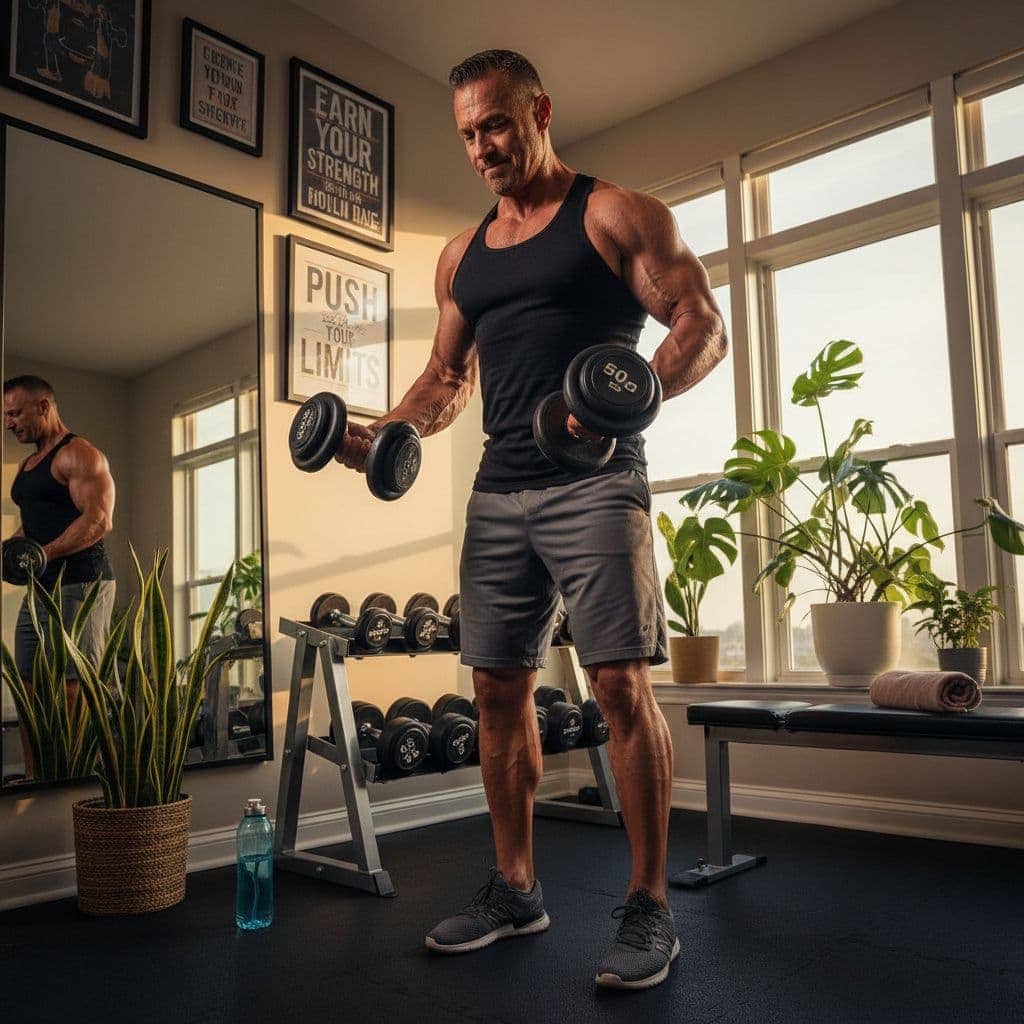
Small Space Home Workout With Dumbbells (8 Moves For A 6×6 Foot Room). If you are a busy professional in small spaces like a tiny apartment, bedroom, or office, a workout can feel impossible. The room is full of furniture, the floor is crowded, and you worry you will hit a wall with every rep.
Small spaces shouldn’t limit progress. For more space-friendly fitness habits, join my fitness newsletter and get the free 7-Day BODi Trial Blueprint that keeps workouts simple and actionable.
A 6×6-foot space is smaller than it sounds. Think of a yoga mat, with a little room on each side for your arms and a bit of space in front of your toes. That is all you need for a small space home workout with dumbbells that trains your whole body.
This guide gives you a simple dumbbell workout you can run in that tiny square. You only need essential exercise equipment like dumbbells and your body weight, no bench and no fancy setup. You will learn how to lay out your space, follow 8 dumbbell exercises, and use a quick 20-minute total-body workout that fits a busy day.
See recommended dumbbellsHere is a short full-body workout that also works well in tight areas:
Adjustable dumbbells can save a lot of room, especially if you choose the best adjustable dumbbells for small spaces instead of a full rack. Use that video for ideas, then come back to this plan to build your own small space setup.
Table of Contents
Key Takeaways
- You can build real core strength in a space about the size of a yoga mat.
- A smart layout keeps dumbbells close, clears tripping hazards, and protects your shoulders and back.
- Eight basic dumbbell exercises cover your whole body without a bench or machines.
- This routine effectively strengthens the glutes and hamstrings.
- A 20-minute routine fits into a packed workday and still leaves energy for family and hobbies.
How To Turn A 6×6 Foot Area Into A Safe Home Workout Zone
Picture a clear square on the floor that is about 6 feet by 6 feet. That is your tiny home gym. The goal is to provide space for strength training that keeps you strong and safe without moving furniture every time you want to train.
A simple way to measure it:
- If you have square tiles, count 3 tiles by 3 tiles if each tile is about 2 feet.
- If not, lie your yoga mat flat, then leave a bit of room at the top and bottom for your feet and dumbbells.
- You can also lay masking tape in a big square if that helps you see your “gym.”
Keep this space quick to set up. Busy workday? You should be able to clear a shoe or bag from the floor and start within two minutes.
Pick The Right Spot In Your Tiny Room
Look for a place where you can stand and lie down once without hitting anything.
Good spots:
- One side of the bed after you slide a nightstand closer to the wall.
- A corner of your living room, with a chair pushed in.
- The corner of a home office, as long as you can move your chair aside.
You only need space about the length of a yoga mat. Stand in the center, raise your arms out to the sides, and check that you do not tap furniture. For overhead moves, reach both arms straight up without weight to test the ceiling height and any low lights.
If your fingers brush the ceiling, you can still press dumbbells; just keep a small bend in the elbow at the top, and move more slowly.
Smart Layout: Where To Put Your Mat, Feet, And Dumbbells
Imagine looking down at your 6×6 square from above.
- Your mat goes in the middle of the square.
- You stand in the center of the mat for most exercises.
- Place your dumbbells at the front edge of the mat, near your toes, or just off to the side of your front foot.
Try not to set dumbbells behind your heels. Reaching back to grab them makes you twist and lean, disrupting proper form and raising the risk of tripping or pulling your back. This correct layout enhances stability and balance, letting you:
- Squat and hinge without hitting a wall behind you.
- Lunge forward or slightly back, staying inside the square.
- Step back from the front of the mat for rows or presses, then lie down in the same space for floor work.
Think of your dumbbells like shoes at your feet, always easy to reach without turning around.
Choose Space Saving Dumbbells For Tiny Apartments
If you are tight on room, one pair of adjustable dumbbells usually beats a whole set of fixed weights. A single pair can replace 5 or more pairs of regular dumbbells, saving money and space.
Many people in small apartments start with a compact set that adjusts from light to moderate loads. For help picking a set that fits in a closet or corner, check out this guide to the best adjustable dumbbells.
Store this necessary exercise equipment in its cradle near a wall so your 6×6 workout zone stays clutter-free.
8 Dumbbell Exercises You Can Do In A 6×6 Foot Space
These dumbbell exercises hit every major muscle group and stay within your square. You will train legs, glutes, back, chest, shoulders, arms, and core, with no bench and no walking lunges. These dumbbell exercises require minimal space while delivering full-body results.
Use a weight that feels hard but still safe. On each set, you should feel like you could do 1 or 2 more reps with good form.
1. Goblet Squat: Leg And Core Strength Without A Squat Rack
What it works: quads, glutes, and core muscles.
Hold one dumbbell upright at your chest, like a big cup. Stand with feet just outside hip width, toes slightly turned out. Sit your hips back and down, keep your chest up, and push your knees out in line with your toes.
All the motion is straight up and down, so you stay well inside your 6×6 space. This dumbbell exercise is great if you spend most of your day sitting and want stronger legs, better posture, and core strength.
2. Dumbbell Deadlifts: Build Strong Hamstrings In One Step Of Space
What it works: hamstrings, glutes, and lower back support.
Hold two dumbbells in front of your thighs, feet under your hips, knees slightly bent. Push your hips back like you are closing a car door, keep your back flat, and let the dumbbells slide down the front of your legs.
One key cue: keep the dumbbells close to your legs. The move is mostly forward and back, so it fits perfectly in a tight square. Dumbbell deadlifts help take pressure off your lower back during long desk days while strengthening the glutes and hamstrings.
3. Standing Overhead Press: Shoulder Power In A Low Ceiling Room
What it works: shoulders and triceps.
First, stand in your square with no weight and reach straight up. If your fingers touch the ceiling, use slightly bent arms when pressing.
Hold dumbbells at shoulder height, feet at hip width. Brace your core, squeeze your glutes, and press the weights overhead. Do not lean back or arch your lower back.
This move focuses on shoulder strength while using almost no floor space.
4. One Arm Row: Back Strength Using Only Half Your Squat
What it works: upper body and lats.
Stand in a staggered stance, front foot in the center of the mat, back foot slightly behind. Hinge forward a bit with a flat back. You can rest your free hand on your front thigh or on a stable chair inside your square.
This single-arm training lets you hold one dumbbell in the other hand and pull your elbow toward your hip, then lower with control. You can even face a wall and still row without hitting it. This helps undo rounded shoulders from long computer sessions.
5. Floor Dumbbell Press: Bench Press Results On The Floor
What it works: chest, shoulders, and triceps.
Lie on your back on the mat, knees bent and feet flat. Hold dumbbells just outside your chest, then press them up over your chest, not your face. Pause, then lower until your upper arms touch the floor. The floor limits the range of motion, which can be friendlier on your shoulders than a bench.
This dumbbell press is one of the most effective chest exercises. To finish the set, bring the dumbbells to your chest, roll to your side, then sit up so you do not drop them from a high position.
6. Split Squat Or Static Lunge: Leg Strength Without Walking Lunges
What it works: quads, glutes, and lower body.
From the middle of your mat, step one foot forward and the other back, like a short lunge. Keep both feet inside your 6×6 square. Hold dumbbells at your sides.
Drop your back knee toward the floor, then push through your front heel to stand tall. If balance is tricky, shorten your stance and hold on to a wall with one free hand. This replaces long walking lunges that need a hallway.
7. Hammer Curl: Strong Arms In Stand Still Space
What it works: biceps and forearms.
Stand tall with your feet under your hips. Hold dumbbells at your sides, palms facing each other. This hammer curl, a type of bicep curl, targets the biceps. Keep your elbows close to your ribs and curl the weights up, then lower with control.
Your feet do not move, and your arms stay close to your body, so you will not bump nearby furniture. This pairs well with rows and presses for a strong upper body.
8. Dumbbell Russian Twist Or Dead Bug: Core Work On A Small Mat
Pick one of these core moves; both fit neatly on a yoga mat and target the core muscles.
For Russian twists, sit with knees bent, lean back slightly, and hold a light dumbbell at your chest. Keep your heels on the floor if you are new to it. Rotate your shoulders side to side without slamming the weight on the floor.
For dead bugs, lie on your back with hips and knees bent at 90 degrees. Hold a light dumbbell in both hands over your chest. Slowly reach one arm and the opposite leg away from your center, then bring them back and switch sides. Move with slow breathing and control.
For a more advanced core and back variation, try renegade rows. Turkish get-ups are another excellent, space-efficient core exercise. Both exercises only need your body length, which fits well inside a 6×6 space.
For more ideas on full-body strength in tight areas, check out this 6-move dumbbell workout for small spaces.
Sample 20 Minute Small Space Dumbbell Workout For Busy Professionals
Now let us turn those movements into a short plan you can run before work, at lunch, or after a long day to boost your physical fitness.
This 20-minute routine fits entirely within your 6×6 square and requires only one pair of dumbbells. Older professionals can use lighter weights and longer rests. If you are 50 or 60+, you can still gain muscle with smart strength training, as shown in this guide on how men over 60 can build muscle.
Quick Warm Up You Can Do Beside Your Desk
Spend 3 to 5 minutes warming up inside your square:
- March in place for 60 seconds, then gently swing your arms.
- Do 10 arm circles forward and 10 backward.
- Perform 10 slow hip hinges with hands on hips.
- Finish with 10 light bodyweight squats and 10 gentle lunges in place.
Move in a pain-free range and breathe steadily.
20 Minute Full Body Circuit Using The 6×6 Foot Layout
Use a timer if you have one. Work for 40 seconds and rest for 20 seconds, or do 8 to 12 reps per set. Due to its intensity, this dumbbell workout circuit can also aid in fat loss.
Do this circuit 2 or 3 times:
- Goblet squat
- Dumbbell Deadlifts
- One arm row (left; great for single-arm training)
- One arm row (right)
- Floor chest press
- Standing overhead press
- Core move (Russian twist or dead bug) to build strong core muscles
Take 60 to 90 seconds rest after each full round. Every exercise stays inside your square, so you do not need to shuffle furniture between sets.
If you like guided follow-along sessions, this 20-minute full-body beginner dumbbell workout is another good option for a small space.
Beginner And Time Saving Tips For Your Small Space Routine
Keep your first few weeks simple.
- Start light and focus on smooth form.
- Stop each set with 1 or 2 reps left in the tank.
- Do this workout 2 or 3 days per week, with at least one rest day between sessions.
- Add more weight or an extra round when the full circuit feels easy.
If you are older or brand-new to strength training, use fewer sets, more rest, and slower movements to improve stability and balance. Consistent strength training is key to building muscle. A steady, small space home workout with dumbbells is enough to build strength and muscle, as long as you stay consistent and eat enough protein.
Tiny Room, Big Wins: Staying Consistent With Your Small Space Home Workouts
Your 6×6 square may be small, but it can give you big results if you keep showing up.
For busy professionals, the key is to attach this dumbbell workout routine to something you already do every day. For example, train right after morning coffee, at the end of your workday, or before your evening shower.
Track simple details like:
- Date and time
- Exercises and weights used
- How many rounds you finished
- How did you feel on a 1 to 5 scale
Over a few weeks, you will see the numbers climb, boosting your overall physical fitness, and everyday tasks will feel easier.
See recommended dumbbellsSmart FAQs for Small-Space Home Workouts With Dumbbells
How much space do I actually need for a dumbbell workout at home?
Most full-body dumbbell workouts fit in about a yoga mat’s footprint.
If you can:
- Lie down flat without hitting furniture
- Step forward and back one normal step
- Lift your arms overhead without touching the ceiling
Then you have enough space for presses, rows, squats, deadlifts, and floor work.
If space is really tight, focus on static moves like stationary lunges, hip hinges, and overhead presses, instead of big walking or jumping moves.
What weight dumbbells should I buy for a small-space home gym?
Pick weights based on your current strength, not what you hope to lift later. A simple setup for most people looks like this:
| Training Goal | Suggested Dumbbell Range (per hand) |
|---|---|
| New to strength | 5 to 10 lb |
| General fitness | 8 to 20 lb |
| Strong & experienced | 15 to 35 lb |
If you can, start with:
- One lighter pair for shoulders, arms, and rehab work
- One heavier pair for legs, back, and glutes
If budget or storage is tight, a single pair of adjustable dumbbells works well, as long as you can change the weight fast without breaking your flow.
Can I get a full-body workout with only dumbbells and no machines?
Yes, you can train your whole body with just dumbbells and a small floor area.
Key movement patterns to include:
- Squat or lunge (goblet squat, reverse lunge)
- Hip hinge (Romanian deadlift, hip thrust)
- Push (floor press, overhead press)
- Pull (one-arm row, bent-over row)
- Core (loaded carry, dead bug, plank with row)
If you hit these patterns 2 to 3 times per week, use enough weight to feel challenged, and train near fatigue with good form, you’ll build strength and muscle without machines.
How can I keep my small-space dumbbell workouts quiet for neighbors?
Focus on low-impact moves and slow, controlled reps. Helpful tweaks:
- Swap jump squats for goblet squats
- Swap burpees for slow walk-outs or incline push-ups
- Lower weights gently instead of dropping them
- Use a thick mat or folded rug under your feet and dumbbells
If you live in an apartment, avoid fast hopping or running in place. Strength work with dumbbells is usually much quieter than cardio moves.
How often should I do dumbbell workouts at home to see results?
For most people, 3 dumbbell workouts per week is a sweet spot.
A simple plan:
- 2 or 3 full-body sessions each week, with at least 1 rest day between
- 45 to 60 minutes if you have time, or 20 to 30 minutes with focused effort
If you train hard 2 days per week and walk or stay active on other days, you can still make good progress, especially if you’re new to strength training.
What if I only have very light dumbbells? Can I still make progress?
You can, if you change how you train. If your dumbbells feel light, try:
- Higher reps, for example, 15 to 25 per set
- Slower tempo, for example, 3 seconds up and 3 seconds down
- Shorter rest, for example,e 30 to 45 seconds between sets
- Single-limb work, like one-leg deadlifts or single-arm presses
You should reach a point where the last 3 to 4 reps feel hard, yet remain under control. If you never feel challenged, it’s time to invest in heavier weights.
How can I structure a simple, small-space dumbbell workout?
Keep it clean and repeatable. Here is a simple full-body template you can reuse:
- Warm-up (3 to 5 minutes)
Light mobility and bodyweight moves like hip circles, arm circles, and bodyweight squats. - Strength circuit (2 to 4 rounds)
- Goblet squatOne-arm row on each sideDumbbell floor pressRomanian deadliftPlank or dead bug
- Cooldown (2 to 3 minutes)
Gentle stretching for the hips, hamstrings, chest, and shoulders.
All of that fits in a small living room, bedroom, or office corner.
Is it safe to do dumbbell workouts in a very small space?
Yes, as long as you plan your setup and stay aware of your surroundings. Safety tips:
- Clear the area of clutter, cables, and loose rugs
- Check that the overhead space is clear before shoulder or overhead presses
- Point dumbbells away from glass, screens, and mirrors
- Keep pets and kids out of the training area during sets
If a move feels cramped, shorten the range of motion or pick a similar move that fits better in your space.
How do I store dumbbells in a small apartment without making a mess?
Think vertical and hidden storage. Good options:
- A small vertical rack tucked in a corner
- Dumbbells slid under a bed, sofa, or TV stand
- A closed storage bench or ottoman that hides weights inside
If you use adjustable dumbbells, keep them on a low, sturdy stand or mat so you protect the floor and keep the space tidy.
Can dumbbell workouts at home help with fat loss, or do I need cardio machines?
Dumbbell workouts help a lot with fat loss because they build muscle, which raises daily calorie use. To support fat loss:
- Train with dumbbells at least 2 to 3 times per week
- Add simple low-impact movement, like brisk walks or stair climbing
- Pay attention to nutrition and portion sizes
You don’t need a treadmill or bike if you keep your strength work consistent and move more in daily life.
Get weekly fitness tips in your inbox
See recommended dumbbellsConclusion
You do not need a full gym or a spare room to get stronger. A simple dumbbell workout can live inside a 6×6 square in your bedroom, office, or studio.
Set up a safe layout, pick 8 dumbbell exercises from this guide, and use the short full-body circuit as your base plan. Over time, you will add weight with adjustable dumbbells, build muscle, gain confidence, and feel stronger during long workdays and weekends.
As you progress, incorporate more dumbbell exercises, including advanced moves like Renegade Rows.
Start small: clear your 6×6 area, grab your dumbbells, and try just one round today. Your tiny room can become the place where you quietly build strength, one short session at a time.