
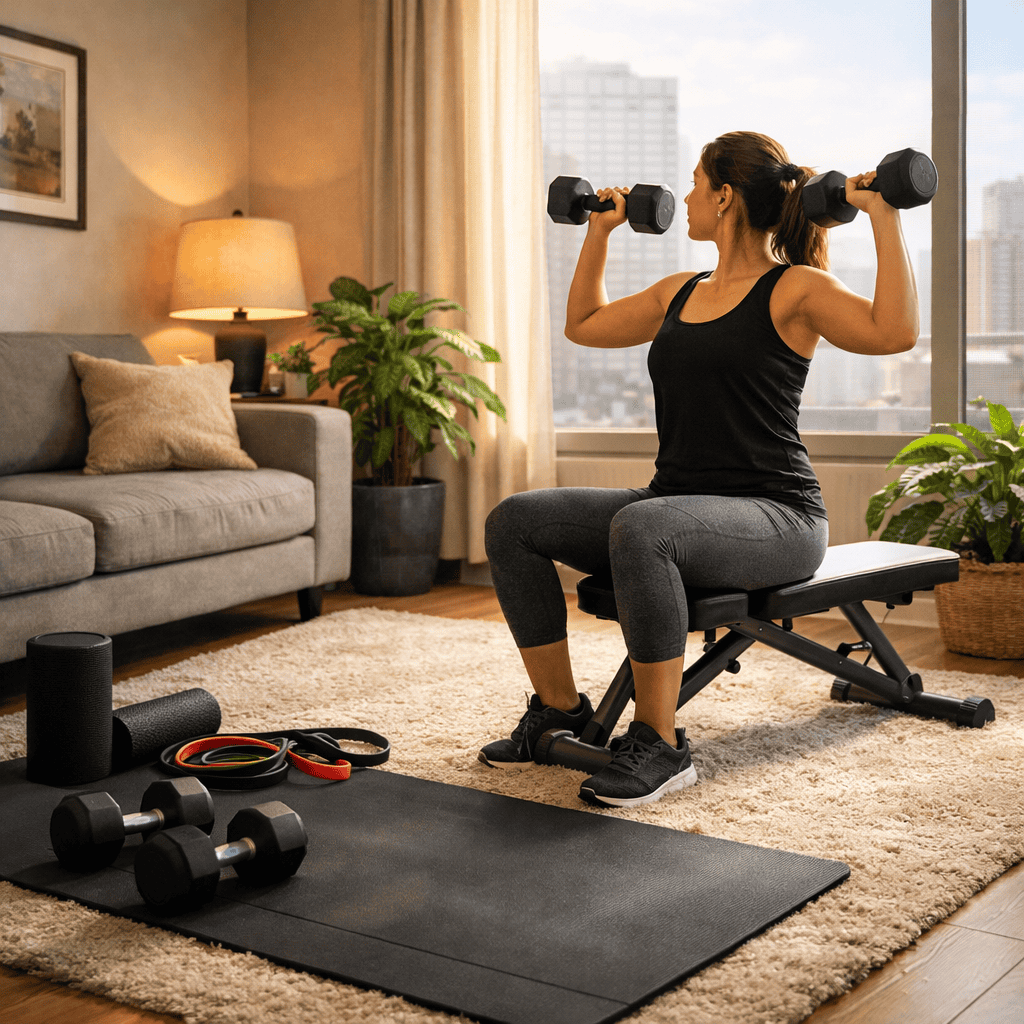
Quiet Apartment Workout Setup (Train Hard Without Annoying Neighbors). Living in an apartment can make training feel like trying to cook a big meal in a tiny kitchen. You can do it, but every clank and thump feels louder than it should.
Thin walls, shared floors, and the fear of a noise complaint can turn a solid workout plan into “maybe I’ll just stretch.”
Want results without a gym? This 20-minute workout fits anywhere 💪
🎥 https://youtu.be/i43mfjPDWAw?si=Z8TfZ8J3pT9nxyVb
A Quiet Apartment Workout Setup fixes that without watering down your training. The goal isn’t to tiptoe through fitness. It’s to keep intensity high while cutting the sounds that travel.
Most apartment workout noise comes from three places: impact (feet hitting the floor), vibration (shaky equipment transmitting through the building), and dropped gear (sudden spikes that sound like a hammer). This guide covers gear choices, room setup, and exercise swaps that keep workouts challenging with less sound.
Key Takeaways
- The loudest apartment workout sounds usually come from impact, not your music or breathing.
- Simple changes in placement and flooring can reduce noise more than buying fancy gear.
- Choose equipment that’s quiet by nature and handle it as if you’re setting down a glass.
- You can keep workouts hard by using tempo, unilateral work, range of motion, and density, even without jumping.
- A short routine for timing, storage, and “quiet reps” prevents complaints before they start.
Table of Contents
Start with the real problem: impact noise vs vibration noise
In apartments, sound doesn’t just travel through air. It travels through the building itself. Floors and walls act like a big drum, carrying certain noises farther than you’d expect.
Here’s the simple breakdown:
- Impact noise: your body hitting the floor. Think jumping jacks, running in place, burpees, jump rope, or even “heavy” step-ups. This often turns into that deep thump neighbors feel.
- Vibration noise: repeated shaking that spreads through the structure. Cheap cardio machines, wobbly benches, rattling dumbbells, or a shaky doorframe pull-up bar can all transmit vibration.
- Sudden spikes: dropping a dumbbell, letting a kettlebell tip over, or slamming an adjustable dumbbell into its cradle. Even once can sound like a small accident downstairs.
A quick reality check: what you hear isn’t always what your neighbors hear. You might notice your playlist and your own breathing. They might only hear the low-frequency thuds. If you want more practical, quiet-at-home cues, this roundup of quiet workout tips for home training lines up with what most apartment dwellers run into.
One more guardrail that helps: respect your building’s quiet hours. You don’t need perfection, just good timing. If you can, schedule anything “borderline loud” for mid-day or early evening, and keep late-night sessions slower and more controlled.
Do a 2-minute noise test before you buy anything
Before spending money, run a simple test in the exact spot you plan to train. The goal is to identify what creates thumps in your space, not someone else’s.
- Stomp once with normal force. Notice how much the floor echoes.
- Do 10 fast step-ups (use a stable step or even a thick book stack if it’s safe). Pay attention to how your foot lands.
- Pick up a weight (or a heavy book), then set it down hard once, and set it down softly once.
- Walk into your hallway or the next room and listen. If you can, step outside your door for 10 seconds and listen there too.
Optional but useful: use a phone decibel meter app to compare surfaces (carpet vs bare floor) and movements (step-back lunge vs small hop). You don’t need lab-grade data; you just need a baseline.
How to use the results:
- If step-ups create the biggest thump, you need more impact control (technique and padding).
- If weights setting down makes the worst sound, focus on gear handling and floor protection.
- If everything feels “boomy,” your fix is usually placement plus layering.
Build a Quiet Apartment Workout Setup with smart flooring and a simple layout
Most people try to solve apartment noise by changing exercises first. Start with the room. A good setup makes almost every move quieter.
Pick your workout zone using three rules:
- Away from shared walls when possible (especially the wall you share with a bedroom).
- Over carpet, if you have it, since carpet absorbs impact better than hardwood.
- Avoid training directly above a neighbor’s bedroom if you can tell the layout (many apartments are stacked similarly).
Next, think in layers. A single yoga mat on hardwood is like putting a napkin under a plate and calling it “table protection.” It helps a little, but not much.
If you want a deeper breakdown on thickness, grip, and stability for small rooms, see the best workout mats for small spaces and apartments. The key idea is simple: you want dense and stable, not just thick.
A note that surprises people: very thick, squishy mats can still transmit vibration even when wobbling. If your foot sinks and shifts, you’re creating movement that becomes noise.
The quiet floor stack that works in most rentals
Use what your apartment gives you, then add the smallest effective upgrade.
Option 1: Carpeted room
- Use the carpet as your base.
- Add a dense training mat on top for stability and protection.
- If the mat slides, rotate it or add a thin grippy underlayer that doesn’t feel like a mattress.
Option 2: Hard floors (wood, vinyl, tile)
- Start with a rug (even a medium-pile area rug helps).
- Put a dense mat on top of the rug.
- If allowed, add interlocking tiles under the mat for extra damping, but avoid soft foam tiles that compress like a sponge.
Option 3: You only have a thin yoga mat
- Keep it for floor work and mobility.
- For strength circuits, add a denser mat or a rug under it, so you’re not landing straight onto hardwood.
Small upgrades that prevent “accidental noise”:
- Use furniture sliders to move a bench or step rather than dragging it.
- Store weights in a way that doesn’t clank when you pick them up.
Quick avoid list:
- Cheap foam that compresses fast
- Slick mats that creep across hardwood
- One thin mat on bare flooring for anything dynamic
Quiet gear that still lets you train heavy
You don’t need a barbell and plates to train hard in an apartment. The goal is to choose tools that load muscles without creating impact, rattle, or drop risk.
Quiet, high-value gear choices:
- Adjustable dumbbells (handled carefully, never dropped)
- Kettlebell with a flat bottom (stable set-downs)
- Resistance bands (mini and long)
- Suspension trainer (great for rows and presses with low noise)
- Sandbag (soft set-downs and brutally effective)
- Weighted vest (quiet intensity for squats, step-ups, and carries)
- Push-up handles (reduce wrist strain and keep hands stable)
- Doorframe pull-up bar (installed correctly, with controlled reps)
What tends to get loud fast in apartments:
- Metal plates and barbell work where a drop is possible
- Cheap treadmills (motor hum plus repetitive vibration)
- Wobbly racks or shaky benches that creak and rattle
If you want “heavy” without noise, sandbags and vests are the easiest win. They load your body without turning your floor into a percussion instrument.
Swap loud moves for quiet ones that feel just as hard
The secret to hard training with less noise is knowing which “lever” to pull. If you remove jumps, you can still increase difficulty using:
- Tempo (slow down)
- Range of motion (go deeper or extend the position)
- Unilateral work (one side at a time)
- Density (more work in less time, with control)
Examples that work well in apartments:
- Legs: split squats, step-back lunges, tempo goblet squats
- Push: slow push-ups, feet-elevated push-ups, pike presses
- Pull: band rows, suspension rows, one-arm dumbbell rows
- Core: dead bugs, slow mountain climbers, side planks, hollow holds
If you also train in hotels or on work trips, a quiet approach transfers perfectly. This hotel room no-equipment workout is a good backup plan when space and noise rules are tight.
Low-impact cardio that will not shake the building
Cardio doesn’t have to mean pounding. Think “engine,” not “impact.”
Quiet cardio options:
- Marching intervals (drive knees, soft feet)
- Step-ups with controlled foot placement
- Shadow boxing (light on the feet)
- Incline push-up to slow mountain climber
- Banded walkouts and lateral steps
- Stair walking (only if your building allows it and you’re respectful)
A simple 12-minute quiet session (work 40 seconds, rest 20 seconds, 2 rounds):
- March in place (fast arms, soft landing)
- Shadow boxing (focus on rotation)
- Step-ups (switch lead leg halfway)
- Incline push-up to slow mountain climber
- Banded lateral steps (or bodyweight squat pulses)
- Plank shoulder taps (slow, minimal sway)
Want more quiet movie ideas? This list of quiet workouts for apartments and small spaces is a helpful menu when you’re bored with the basics.
Strength training tricks that replace jumps and drops
Loud moves often have a quiet twin that hits the same muscles.
Try these replacements:
- Burpees → squat to plank walkout (step back, step in)
- Jump squats → tempo squats (3 seconds down) or split squats
- Kettlebell swings (if they get sloppy or loud) → hip hinges, RDLs, or high-rep goblet squats
- Running in place → marching with high knee drive and a strong arm swing
Cues for “quiet reps” that still feel intense:
- Soft feet: land like you’re sneaking past a sleeping dog.
- Controlled lowering: own the descent on squats, lunges, and push-ups.
- Pause positions: 1 to 2 seconds at the bottom increases difficulty fast.
- Set weights down like a glass: no toss, no bounce, no tip-over.
If you’re unsure what counts as “apartment-safe,” this set of quiet exercises for apartment dwellers can help you spot swaps you might not have thought of.
Keep it neighbor-friendly with a simple noise-proof routine
A quiet setup is half the job. The other half is your routine, the small habits that stop problems before they start.
A neighbor-friendly flow:
- Warm up with mobility and activation, not hops and sprints.
- Put any “heavier” work earlier in the day if possible.
- Use headphones, not speakers (bass travels).
- Keep transitions calm, since rushed movement creates extra thumps.
If you want guided sessions that fit a tight schedule (and keep you from improvising loud stuff when tired), check out best 30-minute workout apps for busy professionals. The right structure makes it easier to stay consistent and quiet.
Storage matters too. Most random apartment noise happens while grabbing equipment.
- Keep bands on wall hooks.
- Store dumbbells on a low shelf with a towel under them.
- Use soft bins so gear doesn’t bang around.
If you ever get a complaint, keep it simple: “I’m sorry about that. Can you tell me what you heard and what time it happened? I’ll adjust my workouts and keep it quieter. Would a time window like 6 to 7 pm work better for you?”
Calm, specific, and cooperative usually ends it right there.
FAQ
What if I have downstairs neighbors and hardwood floors?
Prioritize placement and layering. Train over a rug, add a dense mat, and remove jumping. Also, tighten your technique, soft landings, and controlled step-backs make a big difference.
Are shoes louder than barefoot training?
Often yes, especially hard soles. Clean, grippy trainers can help stability, but for quiet training, many people do better with bare feet or soft, flat indoor shoes (as long as it’s safe for your feet).
Can I still build muscle without a barbell?
Yes. Use a slower tempo, pauses, one-leg work, and higher reps. Tools like adjustable dumbbells, bands, a sandbag, and a weighted vest cover a lot.
Is a doorframe pull-up bar safe in an apartment?
It can be, if installed correctly and used with control. Avoid kipping and swinging. If it creaks or shifts, stop and re-check the setup.
What’s the fastest way to make workouts quieter today?
Move your workout zone, add a rug or dense mat, and swap jumps for tempo and unilateral work. Those three changes cover most noise issues.
Conclusion
A Quiet Apartment Workout Setup isn’t about training softly. It’s about training smart. Once you understand the difference between impact and vibration, upgrade your floor stack and placement, pick quieter gear, and swap loud moves for controlled intensity, you can work hard without turning your apartment into a drum.
Today’s simple action plan: pick your quietest spot, add one layer under your mat, and build a short circuit from five quiet moves you can do with great control. Keep it consistent, keep it respectful, and let progress make the noise, not your floor.
**mitolyn reviews**
Mitolyn is a carefully developed, plant-based formula created to help support metabolic efficiency and encourage healthy, lasting weight management.