
Lower Back Exercises at Home With Dumbbells. If you’re in your 60s and you want a stronger back without joining a gym, you’re in the right place. When I say lower back exercises at home with dumbbells, I’m not talking about cranking out painful back extensions and hoping for the best.
I’m talking about building support around the spine, mainly through the hips, glutes, and core, so your lower back stops feeling like it has to do everything.
These moves should feel like honest muscle work, a deep burn in the backside and hamstrings, maybe a little “I’ve used this area” soreness the next day. They should not feel like sharp pain, pinching, or electric shocks.
Dumbbells help because I can load the hips and glutes in a controlled way, which often takes stress off the lower back instead of dumping more into it.
Key Takeaways
- A “strong lower back” usually means a stronger posterior chain (glutes, hamstrings, upper back) plus better core control.
- Dumbbells work great at home because I can train with hinge, row, bridge, and carry movements with simple gear.
- I move slowly, keep a neutral spine, and stop 1 to 2 reps before form breaks.
- “Good discomfort” feels like muscular effort, “warning signs” feel sharp, shooting, numb, or spreading.
- The simplest routine wins: 2 to 3 days per week, same few moves, little progress over 4 to 6 weeks.
Table of Contents
Before I start, how I keep my lower back safe with dumbbells at home
My first rule is simple: I don’t train through weird pain. Muscle fatigue is fine. A strong hamstring stretch is fine. A mild ache later that day can be fine. If I feel pinching, shooting pain, numbness, or pain that travels into the leg, I stop and change the exercise (and I get checked out if it doesn’t settle).
If you want a plain-language overview of back-safe training for older adults, I like seeing how different coaches frame it, for example, expert-approved back-strengthening exercises for seniors.
What does “neutral spine” mean in real life
Neutral spine means my back stays in its natural shape. I’m not rounding like a scared cat, and I’m not arching hard like I’m trying to stick my ribs out.
The easiest way I keep it: I think “ribcage down, belt buckle up.” Then I brace my abs like I’m about to cough.
Quick home setup tips (so I don’t trip or wobble)
I keep it boring:
- Stable shoes (or barefoot if I feel steadier).
- Clear floor space, no rugs that slide.
- A chair or wall nearby for balance on rows and carries.
- Enough room to set dumbbells down without twisting.
If your space is tight, this small-space home gym setup guide can help you arrange a simple training corner without clutter.
My 2-minute warm-up to loosen hips and switch on core
I warm up because stiff hips love to “borrow” motion from the lower back.
Here’s what I do, quick and easy:
- Cat-cow: 5 slow reps, just to loosen the spine.
- Bodyweight hip hinges: 8 reps, hands on thighs, push hips back.
- Glute bridges (no weight): 10 reps, squeeze and pause 1 second.
- Dead bug hold: 2 holds of 10 seconds, slow breathing.
- Gentle hamstring sweep: 5 sweeps per side, no bouncing.
After this, my hips wake up, my core is on, and my back feels more “set.”
The form checks I use on every rep (so my back feels better, not worse)
I run this checklist while I’m lifting:
- Ribcage down, don’t flare.
- Knees soft, not locked.
- Hips back first on hinges.
- Squeeze glutes at the top, don’t lean back.
- Move slowly, no bouncing.
- Stop early (1 to 2 reps before form breaks).
Weight choice matters. I start light enough to control 10 to 12 reps at a steady tempo.
Breathing helps me brace. I inhale on the way down, then I exhale as I stand up and tighten my abs.
The best lower back exercises at home with dumbbells (with simple cues)
I don’t need a dozen fancy movements. The best results come from a few basics I can do well.
I can do these with one dumbbell, two dumbbells, or adjustable dumbbells. If you’re newer to strength training in your 60s, this guide on beginner dumbbell workouts for men over 60 is a solid companion to keep things joint-friendly.
For extra exercise ideas, you can also compare my list to these lower back exercises with dumbbells and see which ones match your comfort level.
Dumbbell Romanian deadlift (my top pick for back-friendly strength)
This is my number one hinge because it targets the hamstrings and glutes without requiring heavy loads.
Setup
- I stand tall with dumbbells at my sides.
- Feet hip-width, knees slightly bent.
- I brace my abs before I move.
How do I do the rep
- I push my hips back like I’m closing a car door with my butt.
- Dumbbells slide down my legs, close to the body.
- I stop when my hamstrings feel tight, and my back still feels flat.
- I stand up by pushing off the floor and squeezing my glutes.
Range of motion rule: I don’t chase depth. I stop where control ends.
Common mistakes I avoid
- Rounding the back (usually going too low).
- Turning it into a squat (knees drifting forward too much).
- Shrugging the shoulders up.
- Bouncing off the bottom.
Regression: I use a shorter range or elevate the dumbbells on blocks to start higher.
Progression: I go from two dumbbells to a heavier pair, or I use one dumbbell “suitcase style” and work each side.
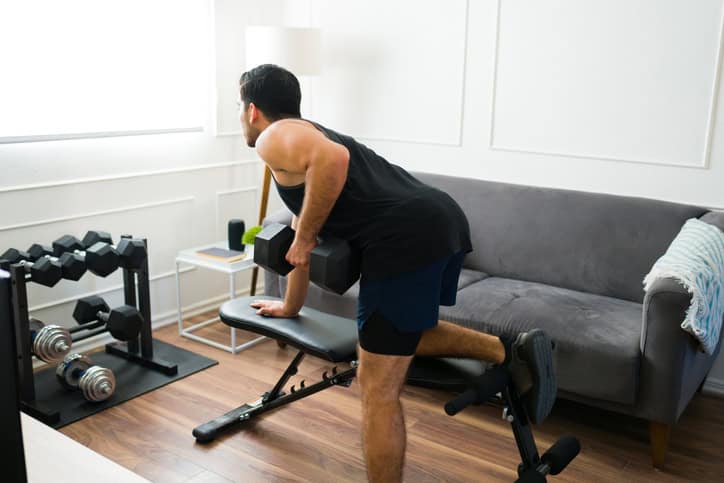
Supported one-arm dumbbell row (I use it to build mid-back support)
A stronger upper and mid-back helps my lower back during daily life. Rows make it easier to stay tall when I’m carrying groceries, doing yard work, or standing at the counter.
Setup
- One hand is on a chair, the other hand holds the dumbbell.
- Hips square, spine long, neck relaxed.
- I keep most of my weight through my feet, not hanging on the chair.
Row cues that keep it clean
- I pull my elbow toward my hip, not straight up to my armpit.
- I pause for 1 second at the top.
- I lower slowly, 2 to 3 seconds.
If I feel my torso twisting, the weight is too heavy or I’m rushing.
Dumbbell glute bridge or hip thrust (I train glutes to unload my low back)
If standing hinges bother my back at first, bridges are often a friendlier start. They let me train the hips while my spine stays supported.
How I set it up
- I lie on my back, knees bent, feet flat.
- I place one dumbbell across my hips (I pad it with a folded towel if needed).
- I brace my abs to avoid over-arching.
How I lift
- I drive through my heels.
- I squeeze my glutes at the top for 1 second.
- I stop at a point where ribs stay down, and I’m not cranking my lower back.
Option: If I’m stable and pain-free, I try a single-leg bridge, but only when the basic version feels easy and solid.
Suitcase carry (the simple move that trains side-to-side core strength)
This one looks too easy until you do it right. It trains the “don’t bend” strength that protects the spine when I carry bags, lift awkward objects, or even walk on uneven ground.
How I do it
- I hold one dumbbell at my side.
- I stand tall, shoulders level, no leaning.
- I take short, controlled steps and breathe slowly.
Beginner dose
- 20 to 40 steps per side, 2 to 3 rounds.
- If space is tight, I march in place for 20 to 30 seconds.
It should light up the obliques and grip more than the low back. If my low back feels cranky, I go lighter and slow down.
My simple dumbbell routine for a stronger lower back (20 to 30 minutes)
I keep the order consistent: warm-up, hinge, row, bridge, carry. It’s simple on purpose.
If you like follow-along structure, a guided plan can help you stay consistent, and something like BODi’s short home training sessions can be useful as a supplement to your own dumbbell work.
Beginner routine (2 days per week) for men over 60
I do this on non-back-to-back days, like Monday and Thursday.
- Warm-up: 2 minutes
- Dumbbell Romanian deadlift: 2 to 3 sets of 8 to 10 reps, rest 60 to 90 seconds
- Supported one-arm dumbbell row: 2 to 3 sets of 10 to 12 each side, rest 60 seconds
- Dumbbell glute bridge: 2 to 3 sets of 10 to 15 reps, rest 60 seconds
- Suitcase carry: 2 to 3 rounds each side, rest as needed
Effort guide: I aim for about 6-8 out of 10. Challenging, but I could do 2 more reps if I had to.
“If this hurts” swap list
Pain is feedback. I use it to adjust, not to quit.
- Romanian deadlift bothers my back: I shorten the range, go lighter, or do glute bridges first.
- Rows bother my back: I raise the support higher (hand on a countertop) and reduce the dumbbell weight.
- Glute bridges pinch: I reduce the top range and keep ribs down, or I drop the weight.
- Carrying irritates my back: I cut the distance in half and slow my steps.
How I progress without tweaking my back (weight, reps, tempo, and range)
I don’t chase big jumps. I chase clean reps.
Here’s my simple progression rule:
- Add reps first until I hit the top of the range with good form.
- Then add a small weight jump (even 2 to 5 pounds per dumbbell).
- Then add a slower lowering (3 seconds down on hinges and rows).
- Then increase range of motion slightly, only if pain-free and controlled.
If I’m sore, tired, or my back feels “off,” I deload for a week. I cut sets in half and use lighter weights. I still train, but I leave the workout feeling better than when I started.
My stopping rules are strict:
- Form breaks.
- Pain shows up.
- I can’t control the rep speed.
I also keep quick notes after training: weight used, reps, and how my back felt the next morning. That one habit keeps me honest.
For general strength ideas that fit older adults, I like the dumbbell approach, then I tailor the moves to what my back tolerates.
Frequently Asked Questions (Lower Back Dumbbell Exercises)
What are the best lower back exercises at home with dumbbells?
The best dumbbell-friendly lower back exercises usually focus on the posterior chain and core stability—such as Romanian deadlifts, supported one-arm rows, glute bridges (with a dumbbell), and suitcase carries. These strengthen the muscles that support your spine without requiring machines.
What are the best lower back exercises at home with dumbbells?
The best dumbbell-friendly lower back exercises usually focus on the posterior chain and core stability—such as Romanian deadlifts, supported one-arm rows, glute bridges (with a dumbbell), and suitcase carries. These strengthen the muscles that support your spine without requiring machines.
Can dumbbells help strengthen my lower back without a gym?
Yes. Dumbbells let you train hip-hinge patterns and core bracing at home, which helps build strength in the glutes, hamstrings, upper back, and deep core—key muscles that support the lower back.
Can dumbbells help strengthen my lower back without a gym?
Yes. Dumbbells let you train hip-hinge patterns and core bracing at home, which helps build strength in the glutes, hamstrings, upper back, and deep core—key muscles that support the lower back.
How heavy should dumbbells be for lower back exercises?
Start lighter than you think and prioritize perfect form. Choose a weight you can control for all reps without rounding your back or losing balance. You can gradually increase the weight once the movement feels stable and pain-free.
How heavy should dumbbells be for lower back exercises?
Start lighter than you think and prioritize perfect form. Choose a weight you can control for all reps without rounding your back or losing balance. You can gradually increase the weight once the movement feels stable and pain-free.
How often should I perform lower-back dumbbell exercises?
Most people do well with 2–3 sessions per week, with at least 24–48 hours between sessions. If you’re a beginner or returning from time off, start with 2 days per week and build up slowly.
How often should I perform lower-back dumbbell exercises?
Most people do well with 2–3 sessions per week, with at least 24–48 hours between sessions. If you’re a beginner or returning from time off, start with 2 days per week and build up slowly.
Should I train my lower back directly if I have back pain?
If you have sharp, radiating, or worsening pain, get medical guidance first. If your pain is mild and movement feels okay, focus on pain-free ranges, slow tempo, light weights, and core stability. Stop any exercise that increases symptoms.
Should I train my lower back directly if I have back pain?
If you have sharp, radiating, or worsening pain, get medical guidance first. If your pain is mild and movement feels okay, focus on pain-free ranges, slow tempo, light weights, and core stability. Stop any exercise that increases symptoms.
What’s the safest way to do a dumbbell hip hinge (like an RDL)?
Keep a neutral spine, brace your core, and hinge by pushing your hips back (not by bending your spine). Keep the dumbbells close to your legs, move slowly, and stop the set if you feel your lower back doing all the work.
What’s the safest way to do a dumbbell hip hinge (like an RDL)?
Keep a neutral spine, brace your core, and hinge by pushing your hips back (not by bending your spine). Keep the dumbbells close to your legs, move slowly, and stop the set if you feel your lower back doing all the work.
Are lower back dumbbell exercises safe for men over 60?
They can be, as long as you use light-to-moderate weights, controlled tempo, and stable variations (like supported rows or suitcase carries). Progress gradually and prioritize balance, posture, and recovery.
Are lower back dumbbell exercises safe for men over 60?
They can be, as long as you use light-to-moderate weights, controlled tempo, and stable variations (like supported rows or suitcase carries). Progress gradually and prioritize balance, posture, and recovery.
What mistakes cause lower back exercises to feel worse?
Common mistakes include using too much weight, rushing reps, rounding the lower back, skipping bracing, and not engaging the glutes/hips. Another big issue is doing too many high-fatigue sets without enough recovery.
What mistakes cause lower back exercises to feel worse?
Common mistakes include using too much weight, rushing reps, rounding the lower back, skipping bracing, and not engaging the glutes/hips. Another big issue is doing too many high-fatigue sets without enough recovery.
Do I need core exercises with dumbbell lower-back workouts?
Yes. A stronger core helps you brace and stabilize during hinge, row, and carry movements. Pair dumbbell training with simple core work like dead bugs, bird dogs, side planks, or suitcase carries for the best results.
Do I need core exercises with dumbbell lower-back workouts?
Yes. A stronger core helps you brace and stabilize during hinge, row, and carry movements. Pair dumbbell training with simple core work like dead bugs, bird dogs, side planks, or suitcase carries for the best results.
How long does it take to strengthen the lower back?
Many people feel improved stability in 2–4 weeks with consistent training. Noticeable strength and endurance gains typically build over 6–12 weeks, especially when you progress gradually and stay consistent.
How long does it take to strengthen the lower back?
Many people feel improved stability in 2–4 weeks with consistent training. Noticeable strength and endurance gains typically build over 6–12 weeks, especially when you progress gradually and stay consistent.
Conclusion
The best lower back exercises at home with dumbbells aren’t about isolating the lower back; they’re about teaching my hips, glutes, and core to carry the load. I start light, move slow, and treat good form like it’s the whole point, because it is. I run the routine for 4 to 6 weeks before I judge results. Pick 2 to 4 moves, train them 2 to 3 times per week, and pay attention to how your back feels the next day (stiff is fine, sharp pain isn’t).
1 thought on “Lower Back Exercises at Home With Dumbbells (Safe, Simple Strength for Men 60+)”