
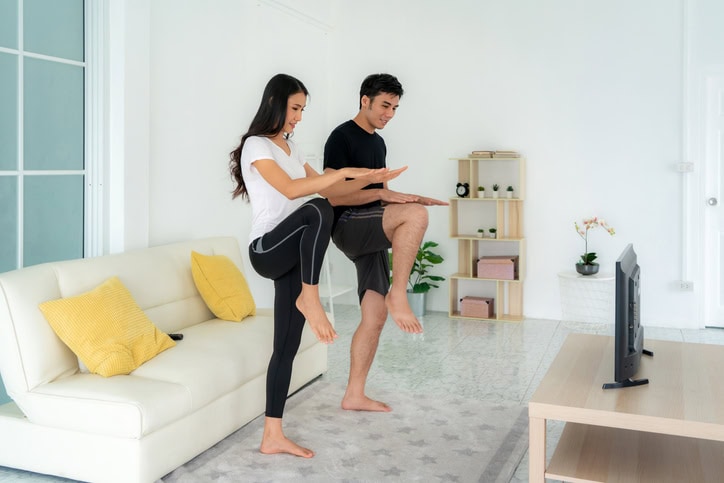
How to Modify HIIT Workouts for Beginners at Home. You’re a busy adult. HIIT sounds perfect on paper. Quick workouts to burn calories, big sweat, done fast. Then you try one video, your lungs catch fire, your knees complain, and you wonder if you’re “just not built for it.”
Here’s the truth: HIIT (high-intensity interval training) is simply short bursts of hard work followed by planned rest. High-intensity interval training delivers benefits like improved cardiovascular health and its famous afterburn effect, which keeps torching calories even after you finish, explaining why it’s popular for real results.
Hotel rooms. Living room. Anywhere space. Try it for free 🚀
🎥 https://youtu.be/i43mfjPDWAw?si=Z8TfZ8J3pT9nxyVb
Beginners should modify it to stay safe, build consistency, and keep their joints comfortable long enough to see results. You can do that at home with bodyweight, a chair, and maybe light dumbbells.
Key Takeaways
- I start by checking readiness so I don’t push too much intensity on a tired body.
- I warm up for 5 minutes, because it makes the hard part feel easier.
- I modify HIIT using five simple levers: impact, work-to-rest ratio (including recovery periods), exercise choice, rounds, and equipment.
- I keep beginner-friendly intensity around “challenging but controlled,” not “destroyed on the floor.”
- I progress one small change at a time, so soreness and burnout don’t take over.
Table of Contents
Before I change the workout, I check these beginner basics
When people say HIIT “doesn’t work for them,” it’s usually not HIIT. It’s the starting point. If I skip the basics, I end up going too hard on a low-energy day, and then I disappear for a week.
Two quick safety notes I always follow:
- Discomfort is normal; sharp pain isn’t. If something pinches, stabs, or changes your movement, I stop and swap the move.
- If you have chest pain, dizziness, numbness, or a condition you’re worried about, it’s smart to talk with a clinician before pushing intensity. For baseline activity guidance, I like the clear targets in the CDC physical activity guidelines.
My 60-second readiness check (breathing, joints, and energy)
I do this before I hit “start” on any timer:
- Sleep: Did I get at least 6 hours?
- Stress: Am I running on caffeine and adrenaline?
- Soreness: Is it mild stiffness, or does it feel deep and heavy?
- Joints: Do my knees, ankles, and shoulders feel normal during a few squats and arm circles?
- Breathing: Can I breathe through my nose while marching in place?
If all signs point to my fitness level, I do HIIT. If I feel run down, I adjust the intensity to a lighter HIIT version (longer rest, lower impact). If joints feel off, I swap to a brisk walk plus mobility.
How I warm up so HIIT feels easier (and safer)
A dynamic warm-up is like easing your car onto the highway instead of flooring it from a stoplight. I keep it simple and repeatable:
- 60 seconds march in place (arms moving)
- 30 seconds arm circles forward, 30 seconds backward
- 60 seconds hip hinges (hands on hips, slow reps)
- 60 seconds chair squats (sit-to-stand pace)
- 60 seconds step-backs (alternate legs, easy range)
- 30 to 45 seconds plank on knees or hands on a couch
The goal is to gradually raise my heart rate and practice the moves slowly before the timer starts.
How to modify HIIT workouts for beginners at home (the 5 levers I use)
When someone asks me how to modify HIIT workouts for beginners at home, I don’t hand them “beginner exercises.” I hand them five levers to modify HIIT workouts for beginner home workouts. Pull one lever at a time, and the workout fits your body today, not some random fitness level on the internet.
Lever 1: I lower the impact first, not the effort
I want you breathing hard, but I don’t want your joints taking a beating.
Common low-impact options I swap at home, like jumping jacks → step jacks:
- Jump squats → chair squats
- Burpees → incline burpees (hands on couch or sturdy chair)
- Jumping jacks → step jacks
My cues: quiet feet, soft knees, and controlled landings. If my knees or shins start yelling, I immediately lower the impact. Breathing hard is fine; joint pain is not.
Level 2: I change work and rest so I can keep good form
Beginners don’t need longer workouts; they need better pacing. I start with intervals that protect form.
Here’s a simple work-to-rest ratio progression I like:
LevelWorkRestNotes110 sec50 secGreat for true beginners215 sec45 secEnough work to feel it320 sec40 secSolid starter standardNext30 sec30 secOnly after form stays clean
My rule is blunt: I stop the set when form breaks, even if the timer says keep going.
I also use an effort check: aim for about 6-7 out of 10. You should be able to say a short sentence, not hold a conversation.
Level 3: I pick simpler moves with the same training effect
Fancy moves look cool, but simple bodyweight exercises that require no equipment build the base. I keep big muscles working and joints in safe positions.
Easy swap list:
- Mountain climbers → slow knee drives
- Push-ups → incline push-ups
- High knees → marching
- Mountain climbers → slow knee drives (controlled pace)
- Floor plank → elevated plank (hands on couch)
- Lunges → split squat holds (tiny range, steady balance)
If you’re shaky, I slow it down. Control beats speed every time.
Lever 4: I reduce total rounds, then add volume later
Most beginners fail HIIT because the session is too long for their current recovery. I’d rather you finish feeling capable than crawl away feeling wrecked.
How I scale a session:
- 2 rounds of 4 moves (about 12 minutes work, plus warm-up and cool-down)
- 3 rounds (about 18 minutes work)
- 4 rounds (about 24 minutes work)
That gives you a clean time menu. On a busy day, 12 minutes is enough. On a good day, add a round.
Level 5: I use simple equipment to make it easier or harder
At home, a chair, wall, or couch is basically a full gym for beginners.
- Easier: incline push-ups, sit-to-stand squats, supported step-ups
- Harder without impact: hold light dumbbells for squats, hinges, and carries
If you’re curious how dumbbells change results without adding stress on joints, here are my at-home dumbbell results and what I learned.
My beginner-friendly HIIT templates you can follow this week
These are built to last about 15 to 30 minutes, including warm-up and cool-down. I keep them adjustable so they fit your day.
Template A: Low-impact HIIT total body workout for total beginners (no jumping)
- Warm-up: 5 minutes (use the warm-up above)
- Main set: 15 seconds work, 45 seconds rest, 6 to 8 rounds
Rotate these 4 moves:- Step jacks
- Chair squats
- Incline push-ups (hands on chair or couch)
- Dead bug (slow core reps)
- Cool-down: 3 to 5 minutes easy breathing + light stretching
Pacing tip: the first round should feel almost too easy. I build intensity by moving more smoothly, not by flailing faster.
Template B: Strength-focused intervals (great if cardio HIIT feels rough)
This one gets your heart rate up with controlled strength work.
- Warm-up: 5 minutes
- Main set: 20 seconds work, 40 seconds rest, 8 to 12 rounds
Cycle these moves:- Goblet squat (or sit-to-stand)
- One-arm row (dumbbell or backpack)
- Hip hinge/RDL (dumbbells or bodyweight)
- Incline push-up
If you want a simple way to turn this into a weekly plan you’ll actually repeat, here’s how I build a home workout routine that actually sticks.
Template C: Busy day micro HIIT (10 minutes, still counts)
I use this when my schedule is chaos and my brain wants to skip.
- Set a timer for 10 minutes (EMOM style)
- Every minute: 20 seconds work, 40 seconds rest
- Alternate just two moves:
- Minute 1: marching fast or step jacks
- Minute 2: chair squats or incline push-ups
That’s it. Consistency beats perfect workouts. You can also adapt these as Tabata workouts or AMRAPs for variety.
How I progress HIIT without getting sore, hurt, or exhausted
My goal isn’t to “survive” HIIT. My goal is to recover fast enough to train again.
Two mistakes I avoid: progressing everything at once, and doing HIIT too many days per week. Both turn a good plan into a crash cycle. This supports sustainable fitness through steady, controlled changes.
My 2-week progression plan (what to change, and when)
Week 1:
- 2 HIIT sessions
- Low impact
- Longer rest (like 15/45 or 20/40)
- Fewer rounds (2 to 3)
Week 2:
- Keep the same exercises
- Change one lever only:
- Add one round, or
- Shorten rest by 5 to 10 seconds, or
- Add light dumbbells to squats and hinges to build muscle strength
On non-HIIT days, I add easy movement like walking. It helps recovery and keeps the habit alive.
How often I do HIIT at home as a beginner (and what I do on other days)
If you’re new, I recommend 2 HIIT days per week to manage intensity. Many beginners do best to stay at 2, and only go up to 3 if sleep and stress are under control. In your high-intensity interval training routine for Week 2, focus on those single adjustments.
Other days, I rotate:
- Walking (even 20 minutes matters)
- Strength training
- Mobility work for the hips, ankles, and upper back
If you’re choosing a program, time and recovery matter as much as the exercises. This comparison can help set expectations: LIIFT4 vs P90X for busy professionals.
FAQ
Should beginners do HIIT to lose weight?
It can help with weight loss, but it’s not magic. HIIT uses short bursts of exercise to burn calories and boost your metabolic rate. I use it as a tool for conditioning and time efficiency, and I keep nutrition and daily steps consistent.
Should beginners do HIIT to lose weight?
It can help with weight loss, but it’s not magic. HIIT uses short bursts of exercise to burn calories and boost your metabolic rate. I use it as a tool for conditioning and time efficiency, and I keep nutrition and daily steps consistent.
How do I know if I’m going too hard?
If your form falls apart, your joints hurt, or you feel wiped out for 2 to 3 days, it was too much. I lower the impact and increase rest.
How do I know if I’m going too hard?
If your form falls apart, your joints hurt, or you feel wiped out for 2 to 3 days, it was too much. I lower the impact and increase rest.
Can I do HIIT if I have knee pain?
I avoid jumping and deep knee angles, and I use chair-based squats and step-backs. If pain persists, I get it checked.
Can I do HIIT if I have knee pain?
I avoid jumping and deep knee angles, and I use chair-based squats and step-backs. If pain persists, I get it checked.
What if I hate “cardio HIIT”?
Do strength intervals (Template B), similar to circuit training. You’ll still get your heart rate up, just in a calmer way.
What if I hate “cardio HIIT”?
Do strength intervals (Template B), similar to circuit training. You’ll still get your heart rate up, just in a calmer way.
Is HIIT safe for beginners?
Yes, HIIT can be safe for beginners when workouts are properly modified. Using low-impact exercises, shorter intervals, and longer rest periods reduces the risk of injury while still delivering results.
Is HIIT safe for beginners?
Yes, HIIT can be safe for beginners when workouts are properly modified. Using low-impact exercises, shorter intervals, and longer rest periods reduces the risk of injury while still delivering results.
How should beginners modify HIIT workouts at home?
Beginners should modify HIIT workouts by reducing impact, shortening work intervals, increasing rest time, and choosing simple movements such as step-backs, marches, or incline push-ups.
How should beginners modify HIIT workouts at home?
Beginners should modify HIIT workouts by reducing impact, shortening work intervals, increasing rest time, and choosing simple movements such as step-backs, marches, or incline push-ups.
How long should a beginner HIIT workout be?
A beginner HIIT workout should last 10–20 minutes. Shorter sessions allow new exercisers to build cardiovascular fitness without excessive fatigue or joint stress.
How long should a beginner HIIT workout be?
A beginner HIIT workout should last 10–20 minutes. Shorter sessions allow new exercisers to build cardiovascular fitness without excessive fatigue or joint stress.
How often should beginners do HIIT workouts?
Beginners should perform HIIT workouts 1–3 times per week, allowing at least one recovery day between sessions to support muscle repair and prevent burnout.
How often should beginners do HIIT workouts?
Beginners should perform HIIT workouts 1–3 times per week, allowing at least one recovery day between sessions to support muscle repair and prevent burnout.
What are good low-impact HIIT exercises for beginners?
Good low-impact HIIT exercises include step-back lunges, bodyweight squats, marching in place, incline push-ups, glute bridges, and low-impact mountain climbers.
What are good low-impact HIIT exercises for beginners?
Good low-impact HIIT exercises include step-back lunges, bodyweight squats, marching in place, incline push-ups, glute bridges, and low-impact mountain climbers.
Can beginners do HIIT without jumping?
Yes, beginners can do HIIT without jumping by using low-impact cardio moves that elevate heart rate without stressing the knees, hips, or ankles.
Can beginners do HIIT without jumping?
Yes, beginners can do HIIT without jumping by using low-impact cardio moves that elevate heart rate without stressing the knees, hips, or ankles.
What’s the biggest HIIT mistake beginners make?
The biggest mistake beginners make with HIIT is doing workouts that are too intense too soon. Proper modification and gradual progression lead to better results and fewer injuries.
What’s the biggest HIIT mistake beginners make?
The biggest mistake beginners make with HIIT is doing workouts that are too intense too soon. Proper modification and gradual progression lead to better results and fewer injuries.
Conclusion
When I keep HIIT beginner-friendly, I focus on five things: lower impact, smarter work/recovery periods, simpler bodyweight exercises, fewer rounds, and helpful equipment. That’s how I get the sweat without the regret.
Start with one template, track how you feel the next day, and progress slowly. Your next step is simple: schedule two high-intensity interval training sessions this week, keep the warm-up and cool-down, and build momentum you can actually maintain.
Yes, HIIT can be safe for beginners when workouts are properly modified. Using low-impact exercises, shorter intervals, and longer rest periods reduces the risk of injury while still delivering results.