
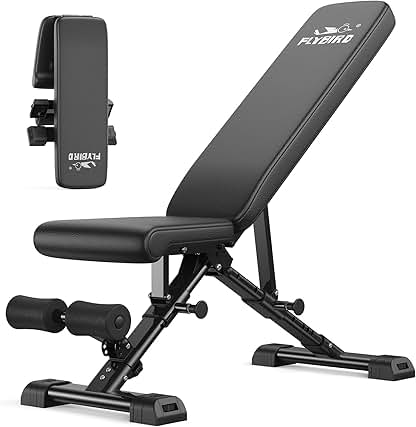
Why a Weight Bench is Essential for Your Home Gym
Best Weight Benches for Home Gyms. A weight bench isn’t just a place to lie down — it’s a foundation for strength training at home.
Whether you’re pressing dumbbells, doing rows, performing seated shoulder presses, or working your core, a bench provides the stability and support your body needs to lift safely and effectively.
Strength training has been shown to help build muscle, improve bone density, increase metabolism, and support long-term health goals.
When paired with free weights or even resistance bands, a quality bench expands the variety of workouts you can perform without adding bulky machines to your space.
Who This Guide Is For
This guide is designed for anyone building a practical, realistic home gym and trying to choose a weight bench that actually fits their space and goals.
It’s especially helpful if you are:
- A beginner looking for a safe, stable bench to start strength training at home
- A busy professional who wants efficient workouts without a full gym setup
- Training in a small space and need a bench that balances versatility and storage
- Using dumbbells or resistance bands, and want to expand exercise options
- Upgrading old equipment and want a clearer comparison before buying
If you’re looking for hype, extreme lifting setups, or commercial gym equipment, this guide isn’t for you. But if you want clear recommendations, practical comparisons, and benches that support consistent training at home, you’re in the right place.
Who This Guide Is NOT For
This guide may not be the best fit if you are:
- Training for competitive powerlifting or bodybuilding and require commercial-grade benches rated for extreme loads
- Outfitting a full garage or commercial gym with multiple specialty benches and attachments
- Looking for the cheapest option possible, regardless of stability or build quality
- Interested only in high-end, premium equipment with advanced customization features
If your goals involve maximal lifting, specialty competition equipment, or outfitting a professional facility, you’ll likely need a more specialized setup than what’s covered here. This guide focuses on practical, well-built benches that support safe, consistent strength training at home.
Types of Weight Benches Explained
Understanding the different types of weight benches can help you choose the right one for your space and goals:
- Flat Bench: The simplest and most common type. It provides a stable surface for traditional pressing and rowing movements and is a staple in most home gym setups.
- Adjustable Bench: Offers multiple backrest angles (incline, flat, decline), making it more versatile for targeting different muscle groups. Adjustable benches are ideal if you want a single bench that does it all.
- Folding Bench: Designed to save space. These benches fold up for easier storage, making them a good choice for limited spaces.
- Specialty Benches: Include preacher curl benches, abdominal benches, and benches with attachments. These are excellent if you want targeted workouts for specific muscles or advanced training options.
How to Choose the Right Weight Bench for Your Goals
What to look for in a weight bench
Choosing a weight bench isn’t just about picking the most expensive model — it’s about finding one that fits your training style, space, and budget.
Here are key factors to consider:
🔥 Adjustability: A bench that adjusts from flat to incline and decline can significantly increase exercise options and target different muscle groups.
💪 Weight Capacity: Always choose a bench with a maximum load rating that comfortably exceeds your bodyweight plus the additional weight you’ll be using. Most quality benches handle 500+ pounds, but some high-end models support significantly more.
🪑 Build Quality: Look for heavy-duty steel frames and durable padding. A solid bench feels stable under load and lasts for years.
📏 Size & Space: Consider your available space before buying. If you have limited room, benches that fold or stow vertically might be better options.
🚪 Portability & Storage: Wheels or handles can make moving the bench easier, especially in smaller home gyms. Lighter benches are easier to reposition but may sacrifice some stability.
Bench weight capacity explained
Warm-Up and Safety Tips Before Using Your Bench
While benches unlock many effective exercises, safety should be a priority. Before every session:
- Warm up your shoulders, wrists, and back with dynamic movement.
- Check the bench’s stability and locks before lifting heavy items.
- Keep a spotter or safety bars nearby if attempting heavy presses.
- Use controlled movements — rapid jerking can compromise form and increase the risk of injury.
Including a safety or tutorial section helps the reader and captures additional how-to search intent, such as “bench press safety tips” or “weight bench warm up routine.”
Bench Workouts You Can Do With Your New Bench
Here are workout ideas that demonstrate the versatility of a home weight bench:
✔️ Flat Dumbbell Chest Press
✔️ Incline Dumbbell Press
✔️ Seated Shoulder Press
✔️ Single-Arm Row
✔️ Step-Ups & Bulgarian Split Squats
✔️ Bench Dips for Triceps
Best Home Workout Equipment for People Over 40 (What I’d Buy and Why)
This post contains affiliate links. As an Amazon Associate I earn from qualifying purchases. I only recommend gear I’d use myself.
Building a home gym in a small space? A solid weight bench multiplies what you can do with dumbbells and bands. These are the best weight benches on Amazon for strength, stability, and storage—without taking over your room.
Quick picks
- Best overall: Adjustable FID bench with ladder back (stable, quick angle changes)
- Best folding bench: Flat/incline folding bench (under‑bed storage)
- Best budget: Entry adjustable bench (great starter value)
- Best heavy‑duty: 800–1,000 lb rated FID bench (lifters)
- Best flat bench: Competition‑height flat bench (stable, no wobble)
- Best compact: Short footprint FID bench (apartments)
| Bench | Type | Back angles | Weight rating | Foldable | Footprint | Link |
|---|---|---|---|---|---|---|
| Adjustable FID (ladder back) | FID (flat/incline/decline) | 6–8+ positions | 600–800 lb | No | Compact | View |
| Folding Incline Bench | Adjustable | 5–7 positions | 500–600 lb | Yes | Under‑bed | View |
| Budget Adjustable Bench | Adjustable | 5–6 positions | 400–600 lb | Often | Small | View |
| Heavy‑Duty FID Bench | FID | 6–9 positions | 800–1,000 lb | No | Larger | View |
| Flat Bench (comp height) | Flat | N/A | 700–1,000 lb | No | Standard | View |
| Compact FID Bench | FID | 5–7 positions | 500–700 lb | Sometimes | Short | View |
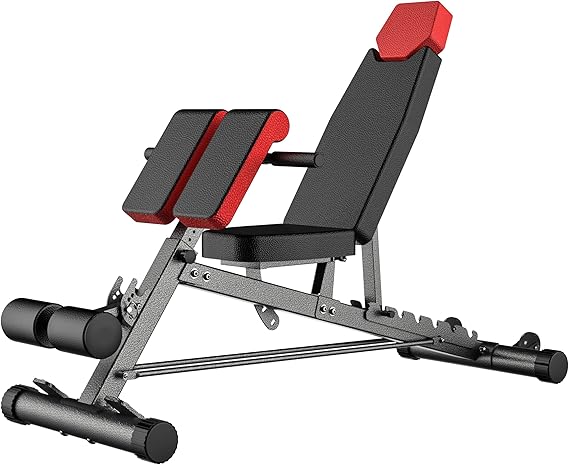
Adjustable FID (ladder back) — Best overall
Stable, quick angle changes, and a compact footprint. Great for presses, rows, and incline work in 30 minutes.
- Ladder back = fast adjustments; no fiddly pins
- Flat, multiple inclines, often slight decline
- 600–800 lb rating on many models
Drawbacks: Costs more than budget benches.
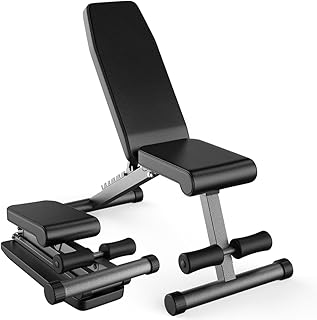
Folding Incline Bench — Best folding
Folds flat to slide under a bed or into a closet. Ideal for apartments or multipurpose rooms.
- 5–7 back positions; quick fold hinge
- 500–600 lb rating typically
- Light enough to move easily
Drawbacks: Slightly less stable than non‑folding benches.
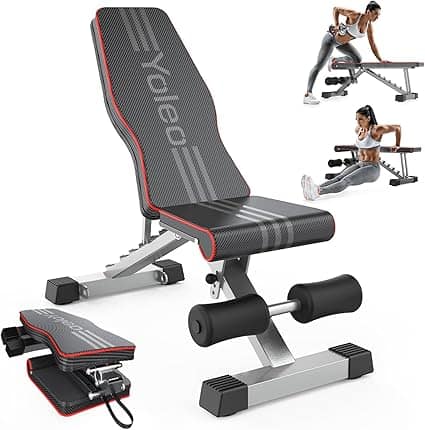
Budget Adjustable Bench — Best budget
Simple, gets the job done for dumbbell presses, rows, and core. Good starter pick if you’re price‑sensitive.
- 5–6 back positions; pin adjustments
- 400–600 lb rating
- Often includes leg holder for sit‑ups
Drawbacks: Narrower pads and more wobble on very cheap models.
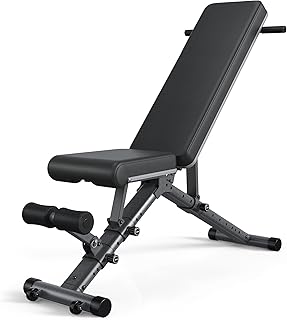
Heavy‑Duty FID Bench — Best for lifters
Thick steel, grippy pad, and high weight rating for serious strength work.
- 800–1,000 lb rating on many models
- Wide, stable base; minimal wobble
- Multiple inclines and solid flat position
Drawbacks: Heavier and larger footprint.
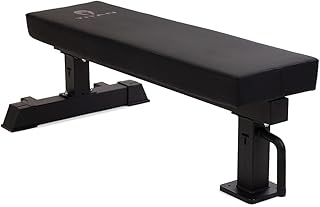
Flat Bench — Best flat (comp height)
The simplest and most stable option if you don’t need incline. Perfect for dumbbell presses and rows.
- 700–1,000 lb rating on many models
- Standard height; grippy pad preferred
- Often lighter and cheaper
Drawbacks: No incline or decline options.
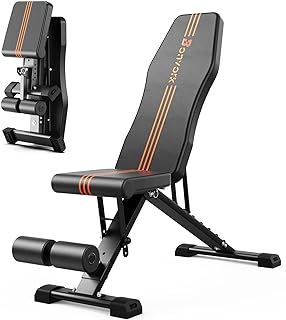
Compact FID Bench — Best for small spaces
Short footprint and quick adjustments make this easy to keep in living rooms or studios.
- 5–7 back positions
- 500–700 lb rating typically
- Easy to move; some fold
Drawbacks: Shorter pad may not fit very tall lifters.
How to choose a weight bench for home
- Stability first: Look for a wide base, grippy pad, and minimal wobble. Check reviews for stability comments.
- Adjustments: Ladder‑back systems change angles faster than pop pins. FID = flat, incline, decline versatility.
- Weight rating: 600 lb+ is a good target for most home lifters; go 800–1,000 lb if you’re heavy lifting.
- Pad height and length: Standard/comp height ~17″. Tall lifters benefit from longer pads.
- Storage: Folding benches slide under beds; wheels help with heavier models.
- Footprint: Measure your space; compact benches keep living rooms usable.
How I tested
- Stability: Presses and rows without rocking
- Adjustability: Speed and accuracy of angle changes
- Pad quality: Grip, firmness, and comfort
- Space fit: Storage and footprint
- Value: Price vs features and durability
FAQs
Is an adjustable bench worth it?
Yes, if you want incline pressing and more angles for back and shoulders. Flat benches are more stable and cheaper if you don’t need incline.
What weight rating do I need?
For most home training, 600 lb+ total rating (user + weights) is fine. Heavy lifters should target 800–1,000 lb benches.
Do I need a folding bench?
If you’re in a studio or bedroom, a folding bench makes storage painless. Otherwise, wheels on a non‑folding bench are enough.
My top pick
An adjustable FID bench with a ladder back hits the sweet spot for stability, speed, and small‑space versatility. If you need storage, grab a folding incline bench.
What type of weight bench is best for a home gym?
For most home gyms, an adjustable weight bench offers the best balance of versatility and space efficiency. It allows you to perform flat, incline, and sometimes decline exercises without needing multiple benches, making it ideal for home strength training.
What type of weight bench is best for a home gym?
For most home gyms, an adjustable weight bench offers the best balance of versatility and space efficiency. It allows you to perform flat, incline, and sometimes decline exercises without needing multiple benches, making it ideal for home strength training.
Is an adjustable bench worth it compared to a flat bench?
An adjustable bench is worth it if you want more variety in your exercise routine. Incline and seated positions allow you to target muscles differently, especially for the chest, shoulders, and upper back. Flat benches are simpler and often more stable, but adjustable benches provide greater long-term flexibility.
Is an adjustable bench worth it compared to a flat bench?
An adjustable bench is worth it if you want more variety in your exercise routine. Incline and seated positions allow you to target muscles differently, especially for the chest, shoulders, and upper back. Flat benches are simpler and often more stable, but adjustable benches provide greater long-term flexibility.
How much weight capacity should a home gym bench have?
A good rule of thumb is to choose a bench with a weight capacity that exceeds your bodyweight plus the heaviest weight you plan to lift. For most people, a bench rated for 500 pounds or more provides a safe margin for strength training.
How much weight capacity should a home gym bench have?
A good rule of thumb is to choose a bench with a weight capacity that exceeds your bodyweight plus the heaviest weight you plan to lift. For most people, a bench rated for 500 pounds or more provides a safe margin for strength training.
Are folding weight benches safe to use?
High-quality folding benches can be safe when properly designed and locked into position. However, they may not feel as stable as heavier, non-folding benches. Folding benches are best suited for lighter to moderate lifting and small spaces where storage is a priority.
Are folding weight benches safe to use?
High-quality folding benches can be safe when properly designed and locked into position. However, they may not feel as stable as heavier, non-folding benches.
Folding benches are best suited for lighter to moderate lifting and small spaces where storage is a priority.
Can beginners use weight benches safely at home?
Yes, beginners can safely use weight benches at home when starting with lighter weights and focusing on proper form. Warming up, checking bench stability, and avoiding rushed movements all help reduce the risk of injury.
Adjustable benches are especially beginner-friendly because they support seated and supported exercises.
Can beginners use weight benches safely at home?
Yes, beginners can safely use weight benches at home when starting with lighter weights and focusing on proper form. Warming up, checking bench stability, and avoiding rushed movements all help reduce the risk of injury.
Adjustable benches are especially beginner-friendly because they support seated and supported exercises.
How much space do I need for a weight bench at home?
Most benches require about 6–7 feet of length and 2–3 feet of width, plus additional clearance for movement and dumbbells. If space is limited, a bench that folds or stores vertically can be a practical solution.
How much space do I need for a weight bench at home?
Most benches require about 6–7 feet of length and 2–3 feet of width, plus additional clearance for movement and dumbbells. If space is limited, a bench that folds or stores vertically can be a practical solution.
What exercises can I do with a weight bench at home?
A weight bench supports a wide range of exercises, including dumbbell presses, rows, shoulder presses, step-ups, Bulgarian split squats, triceps dips, and core movements. Even a basic bench can dramatically expand your home workout options.
What exercises can I do with a weight bench at home?
A weight bench supports a wide range of exercises, including dumbbell presses, rows, shoulder presses, step-ups, Bulgarian split squats, triceps dips, and core movements. Even a basic bench can dramatically expand your home workout options.
How long should a good weight bench last?
A well-built weight bench with a solid steel frame and durable padding can last many years with proper care. Regularly checking bolts, keeping them clean, and storing them in a dry space helps extend their lifespan.
How long should a good weight bench last?
A well-built weight bench with a solid steel frame and durable padding can last many years with proper care. Regularly checking bolts, keeping them clean, and storing them in a dry space helps extend their lifespan.
Final Thoughts: Choosing the Best Weight Bench for Your Home Gym
The best weight bench for your home gym isn’t about having the most features or the highest price tag — it’s about finding a bench that fits your space, supports your training style, and feels stable every time you use it.
Whether you choose a flat bench for simplicity or an adjustable bench for added versatility, a quality bench can dramatically expand what you’re able to do with dumbbells, resistance bands, or bodyweight exercises at home.
By focusing on build quality, weight capacity, adjustability, and how you actually plan to train, you’ll end up with a bench that supports consistency instead of becoming unused equipment in the corner.
A well-chosen weight bench isn’t just a purchase — it’s a long-term investment in safer, more effective strength training at home.
Thank you for your sharing. I am worried that I lack creative ideas. It is your article that makes me full of hope. Thank you. But, I have a question, can you help me?