
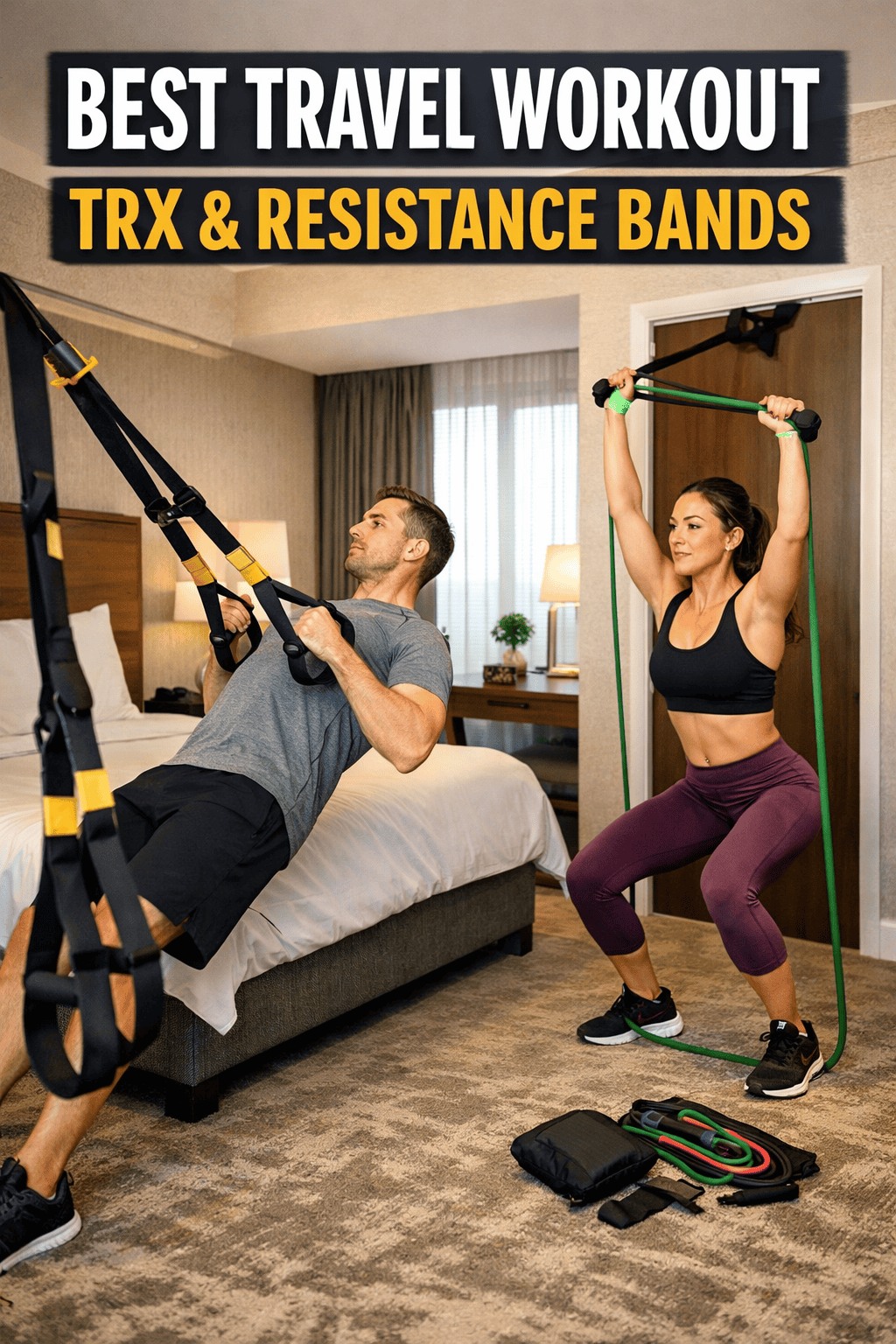
Travel has a special way of breaking good habits. Hotel gyms are tiny (if they exist), meetings run long, and after a flight, my hips feel tight, and my upper back feels stiff. If I wait for the “perfect” time to do my 30-minute full-body workout, the trip ends, and I’ve done nothing.
This is my Best Travel Workout: Combining TRX & Resistance Bands. It solves the real problem: I can train full-body strength, posture, and conditioning through bodyweight exercises in a small room with minimal gear, and its portability lets it fit right in my travel bag.
I’ll also cover safe setup options and exactly how I adjust angles and band tension so it feels right. A quick note before we start: if something hurts sharply or pinches, I stop and swap the move. Travel workouts should make me feel better, not beat me up.
Key Takeaways
When I’m traveling, I’m not chasing personal records. I’m chasing consistency, good reps across key muscle groups, and a body that feels solid when I’m carrying bags, sitting in meetings, or walking all day.
Here’s what matters most in this plan:
\
- TRX gives me scalable strength using body angle in suspension training, so I can push hard without heavy weights.
- Bands fill the gaps for shoulders, hips, and anti-rotation core work that improve core stability and keep my posture from collapsing after long periods of sitting.
- A safe anchor point beats a “creative” anchor every time. I test it before I train, even if I’m rushed.
- I train close to failure, not to failure. Most sets end with 1 to 2 reps left in the tank.
- The workout has a clear structure: dynamic warm-up, two focused circuits, an 8-minute finisher, and a short cool-down.
If you want extra context on why suspension training is so travel-friendly, this piece on bringing a TRX workout on trips matches what I see in real life: small space, quick setup, big return.
The travel setup I use so TRX and bands work in almost any room
My travel kit is simple because I actually want to bring it. If it’s bulky, it “accidentally” stays home.
What I pack:
- A TRX-style suspension trainer (any reputable suspension trainer works)
- One set of loop bands (light to heavy, providing variable resistance)
- One long band (ideally with handles, but a plain long band works)
- A mini band (great for glutes and warm-ups)
- A door anchor (small, light, and worth it)
- Optional grip pads (helpful if bands dig into my hands)
If you’re building or upgrading your band kit, I’d start with quality options that don’t roll or smell like chemicals. This guide is a solid reference, and it’s also how I think about choosing bands by tension and use case: Top Resistance Bands for Home Workouts (2025 guide).
Packing tips that make a difference: - I keep bands in a small pouch so they don’t tangle.
- I bring one “lighter than I think” band for shoulder work.
- If I could bring only one band, I would choose a medium-long one. I can still row, press, hinge, and do Pallof presses.
Before I start, I do a quick mental checklist: anchor, space, plan. Anchor means my straps and bands are attached safely. Space allows me to step back and extend my arms without hitting a lamp. Plan means I know what the next 10 minutes will look like, not just the first exercise.
Safe anchoring options for hotels, rentals, and parks
Most travel workout problems are really anchoring problems. When the anchor is sketchy, everything feels sketchy.
For a door anchor, my rules are strict:
- I place the anchor on the hinge side of the door.
- The door should close toward me, so my pull tightens the door into the frame.
- I close it fully and lock it if possible.
- I add a towel as a buffer if I’m worried about scuffs.
Then I do my 20-second safety test to ensure proper form:
\
- Gently lean back and hold for 3 seconds.
- Harder pull for 3 seconds.
- Check the starting position, do one full rep with control, then I re-check.
If I’m in a rental with other people, I don’t assume they know. I put a towel at the bottom of the door as a visible “do not open” signal, and I tell anyone nearby not to open it during my set.
Outdoors, I’ll use a sturdy tree or a solid railing; a standing position is often preferred. I avoid anything that can move, flex, or snap. What I never use: towel bars, curtain rods, flimsy closet rods, or anything attached to drywall.
If you want more TRX programming ideas beyond this plan, expert TRX workout picks can help you rotate variations without changing your whole routine.
How I choose band strength and TRX angles so every move feels right
Scaling is the whole point of TRX and bands. It’s not “easy equipment.” It’s adjustable equipment.
For TRX:
- Harder: I walk my feet forward (more lean), shorten the straps, narrow my base, and slow the lowering.
- Easier: I stand more upright, lengthen the straps, widen my stance, and keep reps crisp.
For bands: - Harder: I step farther from the anchor, shorten my grip, or use a thicker band.\
- Easier: I step closer, use a lighter band, or reduce the range of motion.
I use a simple effort rule: most sets end at about an 8 out of 10 effort. That means I could do 1 to 2 more clean reps if I had to. On travel days, that’s plenty.
One band detail most people miss: bands get harder near the end of the rep because tension increases as they stretch. So I control the last third of the movement. No snapping into lockout, no bouncing.
My best travel workout combining TRX & resistance bands (30 minutes, full body)
This is the exact structure of my best hotel-room workout, which I repeat on trips. I can do it in a small hotel room, a quiet corner of a gym, or a park if I’ve got an anchor point.
Here’s the plan for this full-body workout at a glance:
| Section | Time | What I’m doing |
| — | — | — |
| Warm-up | 5 min | Undo sitting, wake up joints |
| Circuit A | 12 to 15 min | TRX push, pull, legs |
| Circuit B | 8 to 10 min | Bands for posture, hips, core |
| Finisher | 8 min | Sweat without joint pounding |
| Cool down | 2 to 3 min | Breathing, hips, chest |
Progression is simple: if I hit the top of the rep range with clean form, I make the angle steeper or increase band tension next time.
5-minute dynamic warm-up to undo sitting and wake up my joints
I don’t skip this on travel days because it makes the main workout feel smoother. I stay mostly standing, no floor needed.
I go 30 to 45 seconds each:
- Brisk march or step jacks (arms loose, breathe through the nose if I can).\
- Hip hinge patterning (hands on hips, push hips back, feel hamstrings).\
- Band pull-aparts (shoulders down, squeezing shoulder blades together).\
- Lunge with reach (easy stride, reach up and slightly back).\
- Ankle rocks or calf pumps (slow and controlled).
Breathing cue I use the whole time: exhale like I’m fogging a mirror, then keep my ribs down as I inhale. That tiny change helps my posture fast, especially after hours of sitting.
Circuit A: TRX strength for push, pull, and legs without heavy weights
I do 3 rounds. Each move is 8 to 12 reps. After I finish all three exercises, I rest 45 to 75 seconds, then repeat.
1) TRX Row, a variation of the inverted row (pull)\ I keep my body in a straight line and lead with my chest, not my chin. I think “ribs down, glutes tight.”
Common mistake: shrugging up toward the ears. I keep my shoulders away from my ears.
- Easier: stand more upright.
- Harder: walk feet forward, pause for 1 second at the top.
2) TRX Split Squat or TRX Squat to Reach (legs)\ If my knees feel good, I choose split squats, a lunge pattern. If they feel cranky, I do support squats and reach forward slightly for counterbalance.
Cues: front foot flat during lunges or squats, back knee drops straight down, light grip on straps (I’m not yanking myself up). - Easier: smaller range of motion.
- Harder: slow 3 seconds down, smooth drive up.
3) TRX Chest Press (push) I set my hands at chest level and keep my body like a plank. My elbows track about 30 to 45 degrees from my sides. This chest press keeps tension throughout.
Common mistake: hips sagging and low back taking over. I squeeze my glutes and keep my ribs stacked over my pelvis. - Easier: more upright stance.
- Harder: feet closer together, deeper range of motion, slower lowering.
If you want a broader travel training perspective, the New York Times has a useful reminder that a simple routine done consistently wins on the road, see a 20-minute travel workout approach.
Circuit B: Resistance band work for shoulders, hips, and core stability
This circuit makes me feel “put back together,” especially after flights. It’s big for posture and back comfort because it builds upper-back strength, hip stability, core control, and targets the posterior chain.
I do 2 to 3 rounds, 10 to 15 reps each, with short rests (about 20 to 40 seconds) as needed.
1) Band Face Pull\ Anchor the band around the chest to face height. From the starting position, I pull toward my nose, then rotate slightly so my knuckles point back. The goal is the upper back, not the biceps.
Set up note: I check the band for small tears. If it looks worn, I don’t use it.
2) Lateral Band Walks (or Band Glute Bridge, glute kickbacks, or hamstring curls if I’ve got floor space)\ With lateral walks, I keep toes forward and take small steps. Hips stay level.
Common mistake: feet turning out and the band rolling up. I choose a band that sits flat and keep my steps controlled.
3) Pallof Press (anti-rotation core) Band anchored at chest height. I step out so there’s tension, press straight out, pause, then bring it back in.
Cues: glutes tight, ribs down, focus on core engagement, don’t let the band twist me.
If you’re unsure what band types and tensions to keep in your bag, Runner’s World’s resistance band guide is a decent overview of what to look for.
8-minute finisher I use when I want a sweat without pounding my joints
This is where I earn the shower. It’s also where form can fall apart, so I keep it simple. For arm variety, swap in a triceps extension.
Option 1: Interval ladder (20 seconds work, 20 seconds rest)\ Rotate these three moves for 8 minutes:
- TRX mountain climbers (advanced: TRX knee tucks)
- Band thrusters (squat to press)
- Band high pulls (elbows high, control the return)
Option 2: Steady tempo (40 seconds on, 20 seconds off) Same three moves, but at a smoother pace. This is my choice on low-sleep days.
My rule: if I feel my lower back doing the work, I stop and reset my brace. If I can’t fix it in 10 seconds, I switch to a plank hold and finish strong.
How do I adjust this workout for different travel days and different bodies
I’m not the same person on day three of a conference as I am on a normal Wednesday. Sleep changes, step count changes, stress changes. So I don’t force the same intensity every time.
Here are my decision rules:
\
- If I sleep well and feel good, I do the full plan with the finisher.
- If I’m stiff but not wiped out, I keep the full warm-up, do both circuits, then skip the finisher and walk.
- If I’m fried, I do the warm-up and one circuit only, dialing back intensity across muscle groups. I stop while I still feel sharp.
This is how I stay consistent with functional movement without digging a recovery hole.
My quick swap list for knees, shoulders, or a cranky low back
When a joint complains on the road, I treat it like a yellow light, not a stop sign. I swap the move and keep training.
- Lunges like the split squat cause knee pain. I switch to a supported TRX squat, keeping my shins more vertical and limiting the range of motion.
- TRX chest press bothers shoulder: I do a band press at chest height, elbows closer to sides.
- TRX knee tucks feel rough on low back: I swap to TRX plank hold (or floor plank) with core engagement.
- Lateral walks aggravate the hips: I do standing band hip abduction with a light band in the standing position.
Form checks that reduce flare-ups: - I keep ribs stacked over the pelvis (no rib flare).
- I press through the full foot, not just toes.
- I slow down. Speed hides weak positions.
Progression plan for a 1-week trip and a 4-week travel stretch
I like plans that don’t require a spreadsheet. This one is easy.
1-week trip
- Session 1: easier angles, smooth reps, stop with 2 reps left.
- Session 2: same setup; add 1-2 reps per set if form stays clean.
- Session 3 (optional): keep it short, focus on Circuit B and the finisher.
4-week travel stretch - Week 1: pick easier angles and nail technique.
- Week 2: add one round to Circuit B or Circuit A (not both).
- Week 3: increase TRX angle for more body tension or band tension on 1 to 2 moves.
- Week 4: add tempo (3 seconds down) or shorten rest times.
Deload rule for bad sleep: keep the warm-up, do one circuit, then go for a walk. I’d rather show up undertrained than overcooked.
FAQ: Best Travel Workout Combining TRX and Resistance Bands
What is the best travel workout combining TRX and resistance bands?
The best travel workout combining TRX and resistance bands is a full-body routine that uses suspension training for strength and stability, paired with resistance bands for constant muscle tension. This combination allows you to train effectively in hotel rooms, small apartments, or outdoor spaces without heavy equipment.
What is the best travel workout combining TRX and resistance bands?
The best travel workout combining TRX and resistance bands is a full-body routine that uses suspension training for strength and stability, paired with resistance bands for constant muscle tension. This combination allows you to train effectively in hotel rooms, small apartments, or outdoor spaces without heavy equipment.
Are TRX and resistance bands effective for building muscle while traveling?
Yes. When used together, TRX and resistance bands provide enough resistance and time under tension to maintain and build lean muscle while traveling. Adjusting body angle with TRX and band tension makes the workout scalable for beginners and advanced users.
Are TRX and resistance bands effective for building muscle while traveling?
Yes. When used together, TRX and resistance bands provide enough resistance and time under tension to maintain and build lean muscle while traveling. Adjusting body angle with TRX and band tension makes the workout scalable for beginners and advanced users.
How long should a TRX and resistance band travel workout be?
Most effective travel workouts last between 20 and 30 minutes. This duration allows for full-body training while fitting into busy travel schedules and supporting recovery during long travel weeks.
How long should a TRX and resistance band travel workout be?
Most effective travel workouts last between 20 and 30 minutes. This duration allows for full-body training while fitting into busy travel schedules and supporting recovery during long travel weeks.
Can beginners use a TRX and a resistance band for a travel workout?
Absolutely. TRX suspension straps help reduce difficulty by allowing you to stand more upright, while resistance bands provide low-impact tension. This makes the workout safe and effective for beginners, travelers over 40, and those returning from time off.
Can beginners use a TRX and a resistance band for a travel workout?
Absolutely. TRX suspension straps help reduce difficulty by allowing you to stand more upright, while resistance bands provide low-impact tension. This makes the workout safe and effective for beginners, travelers over 40, and those returning from time off.
Is this type of travel workout joint-friendly?
Yes. TRX and resistance band workouts are joint-friendly because they reduce impact and allow controlled movement patterns. This makes them ideal for travelers dealing with stiff joints, long flights, or limited recovery time.
Is this type of travel workout joint-friendly?
Yes. TRX and resistance band workouts are joint-friendly because they reduce impact and allow controlled movement patterns. This makes them ideal for travelers dealing with stiff joints, long flights, or limited recovery time.