
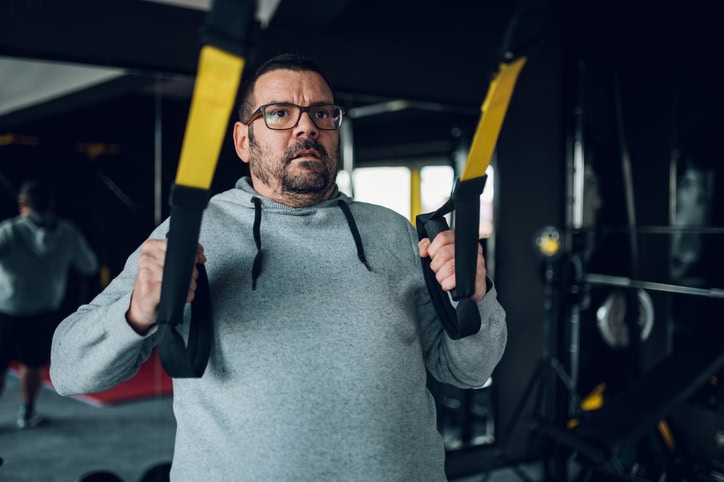
15-Minute TRX Workout for Men Over 50. Most men over 50 I talk to want the same thing: get stronger through resistance training after 50 to combat muscle loss, feel steady on their feet, and keep joints happy, without spending an hour in the gym.
That’s why I keep coming back to TRX suspension training. It lets me train hard with bodyweight instead of heavy loads, so I can dial the intensity up or down in seconds.
👉 Start building real strength today: Grab your resistance training kit now and transform your workouts from basic to badass! — Get it here → https://amzn.to/3ZlXUP2
In this post, I’m sharing my full-body workout plan, built to be fast, full-body, and kind to knees, shoulders, and lower backs. It includes a quick warm-up routine, clear form cues, and options if something feels cranky.
If you’ve had recent surgery, uncontrolled blood pressure, chest pain, or sharp joint pain, get medical clearance first.
Key Takeaways
- I use TRX suspension training because it’s adjustable, balance-friendly, and usually easier on joints than chasing heavy weights.
- This session is a full-body circuit of body weight exercises with a short warm-up, designed to build functional strength, improve balance and mobility, and fit into real life.
- The big “secret” is body angle, not willpower. Small steps change difficulty fast.
- I stop 1 to 2 reps before form breaks, and I breathe on purpose (exhale on effort).
- If I feel dizzy or lightheaded, I pause 30 to 60 seconds, then continue when steady.
Table of Contents
A 15 Minute TRX Workout for Men Over 50 That Trains the Whole Body
This 15-minute TRX workout for men over 50 focuses on joint-friendly strength, balance, and controlled full-body movements that support longevity and daily function.
Before I start, I set up my TRX and prep my body in 3 minutes
I treat setup like a safety check, not a chore. A good anchor makes the whole workout feel solid.
Anchor setup, I trust
- I anchor the TRX straps to a secure suspension trainer anchor point, such as a door anchor that closes away from me, or a solid beam that won’t shift.
- I check for sharp edges and rough surfaces that could cut the straps.
- I give the straps a few strong tugs before I lean back.
Strap length I use most
- Mid-calf length works great for rows and squats.
- Slightly shorter works better for presses and planks, so I’m not fighting slack.
How I choose intensity: The TRX is basically a volume knob. The more I lean, the harder it gets. The more upright I am, the easier it feels. I don’t need to “muscle through” bad reps.
My simple 3-minute warm-up routine
This quick flow uses dynamic movements to boost flexibility and improve muscle activation.
- March in place with tall posture (30 seconds)
- Hip hinges with hands on hips, slow and smooth (30 seconds)
- Shoulder circles, then reach and pull shoulder blades back (30 seconds)
- Ankle rocks, knee over toes gently (30 seconds)
- Easy TRX rows, small range, feel the back turn on (30 seconds)
- Easy TRX squats, sit back, stand tall (30 seconds)
Quick cues I repeat for the lower-body workout: ribs down, breathe through the reps, and lower slowly, like I’m “setting” each joint into place.
My simple rule for choosing the right difficulty (without wrecking my shoulders)
I aim for about RPE 7 out of 10. That means I’m working, but I could do about 3 more reps if I had to.
Here’s the rule I follow to prioritize proper exercise technique:
- Step closer to the anchor to make it easier.
- Step farther from the anchor to make it harder (more lean).
- Keep wrists neutral; do not bend them back.
- Stop 2 reps before my form gets sloppy, especially on presses and planks.
If my shoulders feel pinched, I shorten the range and back off the angle. I’d rather finish clean than grind through pain.
The 15-minute TRX suspension training full workout for men over 50 (timer, exercises, and exact order)
I run this like a simple clock workout.
Format
- 40 seconds work
- 20 seconds rest
- 2 circuits
- 3 moves per circuit
- Repeat each circuit 2 rounds (12 minutes total)
- Add the 3-minute warm-up above (15 minutes total)
This full-body workout plan follows a 40/20 work-to-rest ratio, with sets and repetitions timed for a 15-minute TRX workout. If I get dizzy, I sit or stand tall, breathe, and take 30 to 60 seconds. No hero stuff.
Exercise orderCircuit A:
- TRX Squat to Row
- TRX Chest Press
- TRX Hip Hinge (assisted RDL)
Circuit B: 4) TRX Reverse Lunge (or split squat hold)
5) TRX Y-T-I (or Face Pull)
6) TRX Plank (or Body Saw)
I exhale on effort (standing up, pressing away, pulling in). I inhale on the easier part.
Circuit A: squat and pull, push, then hinge for strong legs and back as part of this lower body workout
1) TRX Squat to Row (combo)
What I focus on: sit back into TRX squats, stand tall, then row with elbows tight.
- Form cues: keep feet planted, chest proud, pull shoulder blades back first.
- Common mistake: turning it into a shrug and yanking with the arms.
- Easier option: a shallower squat depth, stay more upright, and pause between the squat and the row.
- Harder option: deeper squat, slower 3-second lower, lean back more for the row.
Knee note: if my knees complain, I shorten the squat and push my hips back more. The straps help me stay balanced.
2) TRX Chest Press
This is my push move for upper body strength paired with the row, and it’s easy to scale.
- Form cues: body like a plank, hands under shoulders, elbows about 30 to 45 degrees from my sides.
- Common mistake: flared elbows and a sagging lower back.
- Easier option: step in closer to the anchor so I’m more upright.
- Harder option: step farther away, slow lower, pause for 1 second near the bottom.
Shoulder note: if my shoulders feel cranky, I keep the range shorter and stop before any pinch.
3) TRX Hip Hinge (assisted RDL)
This is where I build hamstrings and glutes without loading my spine heavily.
- Form cues: soft knees, push the hips back, keep the spine long, and squeeze the glutes to stand.
- Common mistake: turning it into a squat (knees bend too much).
- Easier option: hinge to mid-shin only, keep hands lightly on straps.
- Harder option: slower lower, reach hips farther back, hold 1 second at the bottom, or progress to TRX hamstring curls.
- Advanced variation: TRX hamstring curls.
Low back note: I feel this in hamstrings and glutes, not in the low back. If my back tightens, I reduce depth and focus on bracing (ribs down, breathe behind the brace).
Circuit B: single-leg training for balance, shoulder stability, and core strength and stability that protects my back
4) TRX Lunges (Reverse Lunge or split squat hold)
Single-leg training is gold over 50, but it has to be controlled.
- Form cues: step back softly, keep the front foot flat, keep the torso tall, use straps for balance.
- Common mistake: crashing into the bottom, or letting the front knee cave inward.
- Easier option: do a static split squat hold (20 seconds per side), or reduce depth.
- Harder option: slower 3-second lower, add a knee drive at the top (only if stable).
Knee pain option: I pick the static split squat and keep the shin more vertical. No sharp pain allowed.
5) TRX Y-T-I (or Face Pull for shoulder comfort)
This is my shoulder health move, great for posture and upper-back strength.
- Form cues: keep shoulders down, move slowly, think “reach long,” not “shrug up.”
- Common mistake: shrugging and arching the lower back to cheat the reps.
- Easier option: face pull with elbows high, lighter lean, shorter range.
- Harder option: steeper lean, 2-second squeeze at the top.
If I feel a shoulder pinch on the Y, I switch to face pulls and keep it smooth.
6) TRX Planks (or Body Saw)
This is core work that should protect my back, not irritate it.
- Form cues: squeeze glutes, tuck ribs down, keep hips level; focus on proper exercise technique.
- Common mistake: hips sagging and shoulders creeping up.
- Easier option: walk feet closer to the anchor (more upright), or hold a shorter plank.
- Harder option: body saw (small forward-back motion), or step feet farther back.
I keep breathing here. If I hold my breath, my neck and shoulders take over.
How I make this TRX workout work for my body (pain-free tweaks and progression)
I’m not trying to “win” a workout. I’m trying to stack good weeks to build lean muscle. So I use fixes that keep training consistent.
Common tweaks I use
These serve as injury prevention exercises to keep me pain-free.
- Knee pain: shorter squat depth, more hip hinge, static split squat holds, TRX lunges, and slower lowers.
- Shoulder impingement: reduce press depth, narrow elbow angle, choose face pulls over Y reps.
- Wrist pain: keep wrists straight, grip handles firm but not death-tight, adjust angle so I’m not collapsing into the joint.
- Low back tightness: brace first, shorten the hinge, skip body saw, and do a steadier plank.
- Balance concerns: widen stance, use straps as “training wheels,” and slow down.
My 4-week progression plan
This progression for TRX suspension training focuses on sets and repetitions while building safely.
- Week 1: learn positions and control, stay conservative with the angle.
- Week 2: increase angle slightly (one small step farther) on 1 to 2 moves.
- Week 3: add a third round to Circuit A or Circuit B (not both).
- Week 4: keep the same angles, cut rest to 15 seconds if recovery is good.
How often do I do it
I like to do this home workout routine 2 to 4 times per week. On off days, I walk, do easy cycling, or do light bodyweight exercises. Recovery still matters at 50-plus: sleep, protein, and hydration do much of the heavy lifting. If you want my weekly workouts and simple recovery reminders, I share them in my Fitness newsletter, which is from Greg.
👉 Start building real strength today: Grab your resistance training kit now and transform your workouts from basic to badass! Get it here → https://amzn.to/3ZlXUP2
Quick form checklist I use so I feel it in muscles, not joints
This muscle-centric technique ensures the work stays in the right places.
- Neutral spine, no rounding or over-arching
- Knees track over toes, no collapsing inward
- Shoulders down and back, no shrugging
- Control the lowering phase for better mind-muscle connection, don’t drop into reps
- No neck tension, keep head in line with spine
- Stop if pain is sharp; burning muscles are okay, but joint pain isn’t
FAQ
Is TRX safe for men over 50?
TRX suspension training can be safe for men over 50, because it’s easy to scale and doesn’t require heavy loading. The key is using a solid anchor, controlling the lowering phase, and choosing angles you can own.
Is TRX safe for men over 50?
TRX suspension training can be safe for men over 50, because it’s easy to scale and doesn’t require heavy loading. The key is using a solid anchor, controlling the lowering phase, and choosing angles you can own.
What if I can’t do a plank without back pain?
I make it easier by stepping closer to the anchor, so I’m more upright. I also focus on squeezing the glutes and keeping the ribs down to improve core strength and stability. If it still hurts, I swap in easier variations like TRX squats or a standing anti-rotation hold with the straps and keep it gentle.
What if I can’t do a plank without back pain?
I make it easier by stepping closer to the anchor, so I’m more upright. I also focus on squeezing the glutes and keeping the ribs down to improve core strength and stability. If it still hurts, I swap in easier variations like TRX squats or a standing anti-rotation hold with the straps and keep it gentle.
Can I build muscle with a 15-minute TRX workout?
Yes, if you train close to your current limit with good form, you will progress over time, building lean muscle, core strength, and stability. The angle changes are your “weights.” Add a little challenge week by week, and you’ll feel it. For leg growth, add variety with TRX hamstring curls.
Can I build muscle with a 15-minute TRX workout?
Yes, if you train close to your current limit with good form, you will progress over time, building lean muscle, core strength, and stability. The angle changes are your “weights.” Add a little challenge week by week, and you’ll feel it. For leg growth, add variety with TRX hamstring curls.
What should I do if my shoulders click or feel pinched on presses?
First, reduce the angle and shorten the range. Keep your elbows closer to your sides and don’t flare them. If it’s still pinchy, I swap chest presses for more rows or face pulls, and talk to a pro if the pain sticks around.
What should I do if my shoulders click or feel pinched on presses?
First, reduce the angle and shorten the range. Keep your elbows closer to your sides and don’t flare them. If it’s still pinchy, I swap chest presses for more rows or face pulls, and talk to a pro if the pain sticks around.
Should I do this workout every day?
I don’t. Most guys do better with 2 to 4 sessions per week focused on sets and repetitions, plus walking. Muscles and tendons need time to recover, especially as we get older.
Should I do this workout every day?
I don’t. Most guys do better with 2 to 4 sessions per week focused on sets and repetitions, plus walking. Muscles and tendons need time to recover, especially as we get older.
Conclusion
I keep this TRX suspension training workout in my back pocket because it’s fast, joint-friendly, and still hits the whole body. Save it, set a timer, and kick off the sets and repetitions two times this week.
Focus on proper exercise technique with clean reps and angle control, then build from there. Consistency builds core strength and stability, improving balance and mobility; it beats perfection every time.